


Resilience skill is a skill that shows our ability to recover when we are in stressful and difficult situations, where we can still come back as a confident person and still have the strength to fight problems or continue living strong.
Many working people may not yet understand the concept of resilience skills. This article will take us to understand more about what resilience is, how important it is for workers and organizations in this era, and how we can develop this skill.
What is resilience skill?
Resilience is the ability to bounce back from a situation with a flexible mindset. To put it simply, it is the symptom of “falling down and getting back up quickly.” Executives from leading global companies are trying to instill flexible thinking skills in their employees.
But the lifelong learning path of humans has a natural leader brain mechanism that few people understand. We call this brain mechanism the “resilient, fighting brain”, which is considered a mental health power that increases mental strength from the frontal lobe of the brain that communicates, plans, thinks before speaking, inhibits, and manages emotions to be resilient, mentally motivated, and thinks to solve life’s problems. The 2022 Journal of Neurology emphasizes that “in the COVID-19 situation, it is a warning sign for us to discover a new vital sign, the mental strength index, which is necessary to assess the maximum potential of an individual to reduce the risk of stressors, insults, injuries, illnesses from diseases, and even disabilities throughout life at every age.”
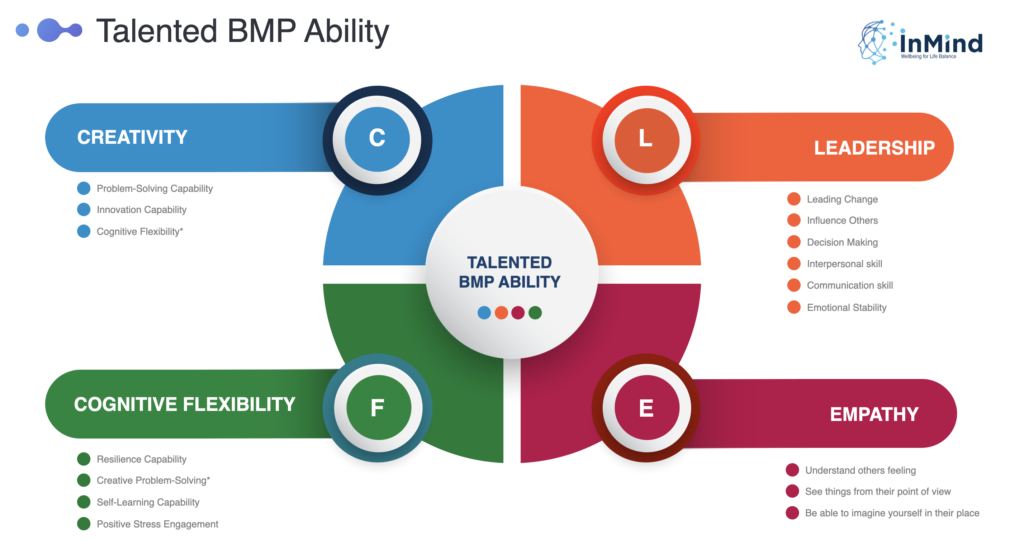
The InMind team studied this issue with the design thinking process until they came up with an innovation for individual brain examination at the health intelligence level and studied the application from the research work of the Mahidol University psychosocial occupational therapists. They found that the important components that should be trained are lifelong learning skills, starting from the age of 8 to 80 years, until they can use the brain’s potential to solve health problems, relationships, communication, and work successfully, even though there are uncertain changes in the organizational context. The health intelligence that the InMind team designed a formula through brain wave calculations to reflect the potential of this brain map consists of 4 parts, referring to the Talented Brain Performance as follows:
- Creativity
- Cognitive Flexibility
- Empathy
- Leadership
How to improve Creativity – How to train your mind to be creative
1. Grit: Mental toughness in physical and technological environments.
By relying on the initial feeling, that is, eating healthy food, getting enough deep sleep, exercising regularly, eliminating toxins from the body and mind, and evaluating and maintaining the balance of one’s own well-being to the fullest potential, always imagining that health will change for the better, having energy to return to a lively body along with being aware and testing one’s own health regularly, which includes solving problems carefully, having patience, perseverance, and reducing the cruelty within one’s mind.
We have the ability to recognize the causes that we cannot control the consequences of every problem. We will constantly review our responsibility for our inner peace. What can we do to help today? Learn that doing nothing is a solution that underestimates ourselves. A life without challenging situations, without the desire for goodwill, without good relationships.
2. Gratitude: Gratitude towards society
The happiness we expect from others is a trigger for disappointment and envy. Think about it, when someone is happy for us, how much of it do we remember? The feeling of little accomplishments each day encourages us to enjoy what we do, to come up with amazing ideas, and to have quality time with others.
So reduce the negative thinking of seeing yourself as important and ordering others around. We feel better about the future, but often we are feeling stressed about the present moment because of our attachment to expecting gratitude from others. Expressing gratitude for something beneficial does not prevent bias or target-attachment with bias in our own minds.
But we are facing challenges and there are still hundreds of goals to overcome to achieve true success. If we can show happiness when others are happy, we will find lasting happiness. This mental happiness will relieve stress with enjoyment, without envy, and will definitely not encounter sadness.
3. Confidence
We are realizing that we are a good person, reflecting on our improved life, criticizing others less, associating with friends with positive thinking, showing sincere kindness, having love and understanding with a world of justice for fellow human beings. When we encounter difficult things, we try to be mindful and criticize ourselves for our strengths, the points that nourish our inner mind and body to grow, having a safe space and being a united group.
We develop from childhood when our brains remember stories of being cared for and rely on others with compassion. Constantly registering positive self-talk in our brains, we read ourselves and others with polite, humble actions, using our full potential, effort, and empathy. Days when we are working hard, building friendships, making mistakes, learning and mastering life skills that help others, being patient, thrifty, and loving ourselves and others.
How to improve Flexibility – How to improve flexibility
1. Courage: Dare to work as a team.
We need to have the courage to speak openly and seriously to others, separating personal experiences from brainstorming and problem-solving, focusing on results. The purpose of problem-solving is to dispel persuasion. Who are you? What do you have to talk about? Smart speech is intentionally positive, truthful, beneficial in a short period of time, unhurried, and desired. When we want to improve, double-check what we think. Will we say something that discourages, hurts, or offend others?
And it can be very helpful if we ask in a polite and understandable way what we hope to do differently or change for the better in the future. Share the learning: How do I feel? Who am I? What is the process like for me to help? What are the truths I am holding back? Only join when you are confident in your expertise and feel a personal desire to help.
2. Aspiration: Ambition that can be controlled flexibly.
Have a growing mindset by focusing on the effort to learn and grow rather than expecting success. It’s okay to make mistakes. Be aware that you are giving your all and knowing what the outcome will be when it’s out of your hands. Don’t let your feelings be the main thing because you can’t make everyone happy, not even your own children. Find a sweet balance in love, work and play. Think of a time in your life when you were happy. Avoid recalling a scary experience because when we have a bad memory, the more we think about it, the longer it takes to think about it. When it comes to the year that we have left, the time flies.
3. Generosity
The process of practicing forgiveness occurs after denying that it is not your fault, changing to anger towards yourself and others, starting to negotiate with others to think that you are not wrong, becoming ashamed of your own faults until you become depressed, and spending a long time communicating with yourself until your mind opens up to accept your faults.
Use your mindfulness to know what we will do and how to release the distracted mind to relax. Let peace of mind be the reward of life. Apologize immediately to maintain the value of being a human being who has done good deeds to each other. Be open-minded, especially forgive yourself for thinking negatively. Most kindness does not involve spending any money. It depends on the gratitude for oneself to show that you are a good person, kind-hearted, and helpful with compassion to do activities in life with a sense of peace.
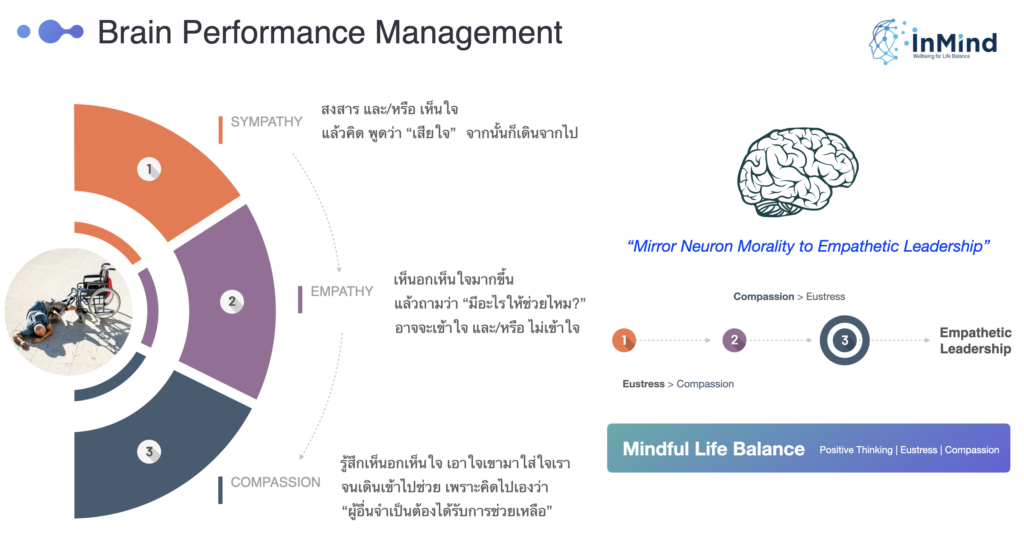
How to improve Empathy- How can we practice empathy?
1. Calm, calm mind
Stimulate the brain’s rest and digestion system. Inhibit the brain’s fight or flight system by relaxing or meditating. And contemplate by writing “Imagination – Imagine the power of anger like the tiger inside us”. Choose between imagining that there is an angry tiger inside us because we think and guess by ourselves. Or there is an angry tiger outside us. But we avoid accepting the mistakes from our own hands. The mind will be calm when our heart forgives ourselves and others. With the power of affirmative words, open your heart to accept mistakes and always improve yourself. To prevent the thief of the heart in the emotional brain, the amygdala, without clinging to judgments of right and wrong and constantly criticizing and finding fault with others with negative thoughts.
2. Motivation: Motivation to give life a goal.
Introduce yourself every day that what are our goals? (Correct, kind, compassionate, how to develop?) Do not quickly judge anyone wrongly until you shed tears or cry immediately. Learn how we can control our likes without stress. Being healthy and motivated will use energy to stimulate caution in negative emotions that are the cause of happiness and love that is full of negative stress. The brain chemical dopamine does not necessarily create motivation to expect rewards all the time. That is, we should practice being a giver more than a taker all the time.
3. Intimacy: Closeness, thinking about people and relationships.
It depends on how much self-centered thinking is hidden within the relationship between us. Maintaining compassion and kindness to each other is not a romantic love show – sweet talk only on the surface. Practice doing good to people around you. Criticize less, have less conflict. Take responsibility for your own behavior. Do not disturb, control your temper, do not cause trouble to others. Do not find fault and prove like a criminal. Do not argue about things that have already ended. Do not criticize excessively. Always remember that they have had uncomfortable days. Try to start talking to them. Tell if we are late to meetings, leave early and arrive on time. Dare to discuss the parts that cause problems and try to understand what they really want.
How to improve Leadership – How to enhance the natural leadership in all of us
1. Compassion: Growing the mind with compassion as a reward for life.
Show love for yourself and be ready to help others in moderation. There is less stress. The body and mind are calm. The more you give goodness, the more you receive goodness. In one breath, or two, or ten breaths, learn to love yourself. We need to accept our true identity, that is, think negatively, think positively, and not think at all. In the basal ganglia of the brain, dopamon is created, which functions to prioritize rewards for our actions, such as we enjoy life, which is the most important energy of concern in every minute of life.
2. Mindfulness Mindfulness
The brain works like a band that holds on to bad experiences, but like a slippery band to good experiences. How do we respond to the real needs so that the mental energy feels green (peace, contentment, and no expectations) and reminds the mind to practice mindfulness to feel the red color to fade, which is fear, frustration, and physical and mental pain? Remove the red mind as quickly as possible. We can say out loud what bad experiences are happening, what feelings are happening, and continue. Finally, think of what we can do to help in order to respond to our feelings so that we get the real needs.
3. Learning is learning to work systematically.
Stimulate and care for the natural changes in the nervous system of “learning how we learn to heal our lives” with the HEAL principle, separated into the following techniques:
- H – Have a positive experience: Have a positive experience.
- E – Enrich it: Enhance your feelings of goodness
- A – Absorb it: Absorb positive thoughts.
- L – Link positive and negative material: Link instead of what was painful. Try thinking about reality.
For example, useful facts, tangible, trustworthy and quantifiable facts, and positive life experiences that come into our lives, not conditions or problems that crowd us out. We all know what the natural process of having a flash of light is like.
Ways to promote a positive experience include:
- Stretch out a good memory and say it out loud for 5-10 seconds.
- Open your mind to positive thinking in a concise and meaningful way.
- Imagine when this memory first occurred in your life and
- What do you value?
We can also try 3 more ways to increase the absorption of positive thoughts into our brains:
- Intentionally think well
- Communicate good ideas with a heart as beautiful as a gem and
- Reward yourself sometimes
We need to detail the challenges around us and dare to face the challenges in our minds, such as self-criticism, the feeling of not wanting anything, and gradually separate the good mind that is us, such as being safe, content, friendly, with love and solving problems quickly by thinking positively and striving to think, speak and act creatively.
All of these are principles that we can train ourselves to have good brain health and to effectively use our brain potential. All 4 elements also affect having Resilience skills .
Source:
Some of the content is referenced from Hanson, R., & Hanson, F. Resilient: Find you inner strength. London: Ebury Publishing; 2018 and the design thinking process that led to the innovation of InMind ‘s personalized brain scan at the health intelligence level.การคิดเชิงออกแบบจนได้นวัตกรรมการตรวจสมองรายบุคคลในระดับปัญญาสุขภาพของ InMind
