


In Search of Excellence – is a book that compiles excellence data from the world’s leading companies for us to learn from. Although it is a collection of data from leading companies in the past, what this book presents can be effectively applied to conducting business amidst the competition and rapid changes in this era.
Running a successful business requires fundamental principles that are reliable, practical, and can make any business owner successful. Finding excellence is one of the most important items on your to-do list for running any business successfully, and this book will help you do just that.
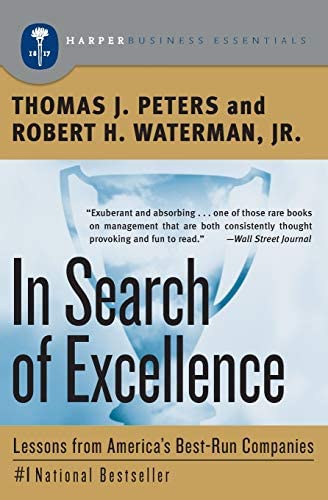
In Search of Excellence, written by Tom Peters and Robert H. Waterman, Jr., was first published in 1982, selling three million copies in its first four years and becoming the best-selling business book in the United States. Compiled from 43 of America’s best-known companies, it has become the greatest business book of all time. It will teach you how to run your business successfully and stay ahead of the competition.
“For any organization to succeed, it must use proven business principles.”
Anyone who plans to build a successful organization should arm themselves with business knowledge and clever strategies. The problem is that theories that suggest how to run a successful business are simply theories that have never been proven, which is why those who follow them continue to fail. Fortunately, our arsenal is backed by research conducted by authors Tom Peters and Robert Waterman, who examined the characteristics of the most successful companies in the United States between 1979 and 1980.
“A good leader brings together conflicting ideas to create a successful outcome.”
After selecting a sample of 43 organizations across 6 sectors, their findings provide a model for the foundational principles of excellence relevant to business today. These 8 principles may seem like common sense, but they are common sense that many organizations overlook.
- Focus on practice
- Close contact with customers
- Freedom to work and be an entrepreneur
- Increase productivity through employees
- Get in close contact with the work, and use values to drive the work.
- Firm your foundation with a business expertise
- Simple structure with few administrative staff
- Strictness and leniency at the same time
“Management failure is one of the most common problems facing business organizations.”
Peters and Waterman looked at businesses in different countries, particularly Japan, where business was growing faster than any other country. They noticed that Japan did not have as many business schools as the United States. This led them to the question of whether Americans were too theoretical. They decided to find out by looking at a list of the top 15 companies in the United States in 1982: Bechtel, Boeing, Caterpillar Inc., Dana, Delta Airlines, Digital Equipment, Emerson Electric, Fluor, Hewlett-Packard, International Business Machines (IBM), and Johnson & Johnson, to see what these organizations had in common.
“To get things done, great companies support action through discovery.”
Peters and Waterman asked the question, what do the best businesses have in common? And they found the answer: bias in action. It doesn’t matter how difficult, how big or small, these companies can get the job done. Bias in action is what makes the difference between the world’s best companies and the ones that are struggling. A clear manifestation of bias in good companies is the willingness to experiment and discover new things.
“Not every company is true to their word.”
Some companies believe they have a bias towards action. Most businesses get caught up in bureaucracy instead of getting things done. Bureaucracy is the practice of controlling people or activities through the use of expertise and authority. Good companies build teams that are obsessed with what they are good at and encourage the participation of people in the company to ensure a smooth flow of work.
“Customer service is essential to the sustainability of an organization.”
Many organizations view consumers as a threat to well-designed business strategies, especially those that primarily sell services. But customer service is a welcome addition to America’s top companies, which consider the needs of consumers in every aspect of their business, from research to sales to accounting. In other words, they take great pleasure in being close to their customers.
For example, Procter & Gamble, one of the most successful companies in history, was the first to add a toll-free number to its products. This simple strategy of keeping customers happy has given Procter & Gamble a platform of trust and support from many people.
“Many of the most innovative companies get their best product ideas from listening intently to their customers.”
While most customer service representatives and assistants serve their bosses, successful companies tell their customer service departments and all personnel to listen to customers as much as possible, solve customer problems within 24 hours, and learn from customers what products and services people need. Providing excellent customer service not only helps companies solve problems and build a customer base, it also gives them ideas for new developments. Every great business needs to know that customers are worth more than sales.
“Internal competition creates healthy competition within the company, stimulates innovation and prevents complacency.”
Smart companies encourage people to be inventors to promote independence and entrepreneurship, which helps employees to develop new ideas outside of their daily work. With the influence of internal competition, there is room for creativity and each person’s ideas that are proposed are compared to increase their performance. This leads to healthy competition outside the company.
“The most successful businesses are those that truly care about their people.”
Great companies prioritize the engagement and well-being of each individual. This involves thorough training, clear expectations, and allowing employees to take initiative and contribute to the work, all of which are ways to foster a positive work environment. Many businesses try to focus on their people and show that they care, but fail to actually do so.
“Create incentive programs that reward good ideas and hard work.”
Successful companies have a long-standing culture of caring for their people. Focusing on people is why businesses continue to improve. The motivation a company creates attracts people to succeed, maintains credibility, and improves performance better than verbal communication. As we all know, communicating and discussing all of a company’s performance metrics with employees rarely motivates employees.
“The ideology that both inspires and drives the company to success.”
It’s a good idea for leaders to define some of the values that the company derives from its actions. Great companies set high values to inspire all employees, no matter their employment level or level of expertise. Everyone can be innovative, not just the people working in R&D. Companies with this mindset are always looking for the next big thing.
“A business should be built on its core strengths so that it can branch out and succeed.”
Competing and expanding into new markets is always a good idea if the company is doing well, but it is not always easy to do. Many organizations do this by creating new products or acquiring companies in other areas, with the goal of making more money in the long run. But to be a smart business owner, you should stick to your area of expertise. Don’t go into a business you don’t fully understand or know how to operate. Businesses need to play to their strengths in order to diversify and make more money.
“A simple corporate structure is the best way to run a large business well.”
Success comes with obstacles. As a company grows, it has more employees, larger departments, and more complex organizational structures. Great organizations overcome this by implementing a solid foundational organizational structure and lean employees in a simple way. A lean workforce means having just the right number of employees, not too many or too few, to minimize the level of management and administration. Instead of having multiple managers or department heads, the work boils down to one person.
“When each department is responsible for its own marketing, distribution and research, better decisions can be made faster and with fewer people.”
Successful companies also need a flexible corporate culture, regardless of their size, but still maintain a strict commitment to the company’s principles. A well-functioning group is a great balance of efficiency and effectiveness. It’s important to let people do things their way. It keeps them focused on the fundamentals, strategic goals, and key financial metrics.
Conclusion
The business world is very competitive and it is easy for many companies to fall behind their competitors, especially when they lack the knowledge of how their company operates. Many companies struggle with internal challenges such as having too many leaders, a lack of coherent ideas, a lack of positive team spirit and a lack of a proven framework for success.
Business people have long argued about what makes a good company. Excellent customer service, outstanding employee benefits and a strong drive to get things done are undeniable characteristics that contribute to business success. Yet many large companies neglect these common characteristics.
“While there is no guarantee of success for every company, paying attention to what successful organizations have done in the past may help you learn a thing or two that you can apply to your own organization.”
Recommended articles:
Dare to lead – Dare to be a leader in a world of constant change.
