

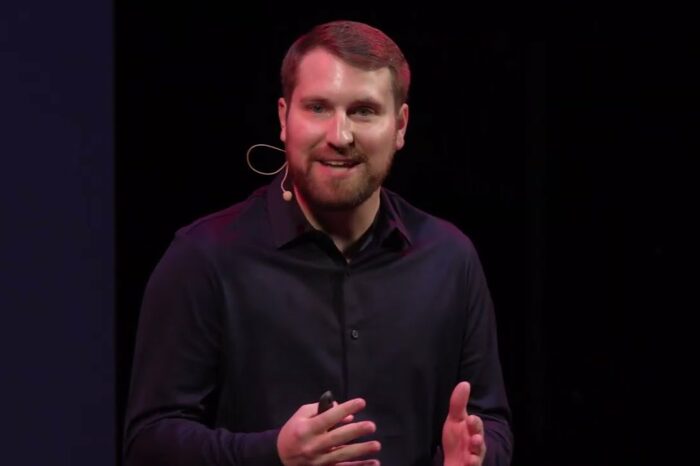
How to get a good job – A question that many people probably want to know, where do talented people find good jobs? Today, let’s try to find the answer from Mr. Taylor Doe , who gave a talk at TEDxOklahomaCity.
Taylor Doe recounted that on February 14, Valentine’s Day, in 2016, he had a moment with a group of five young men whose photos were featured on the front page of Oklahoma’s most popular newspaper. They first met when the boys were just 8 years old. They met when Taylor was working at a school in Northeast Oklahoma. He chose to teach there because he wanted to be close to his family and the kids. He made the right choice, because the kids were so close to him, it was like he had ten or twenty grandchildren to raise.
Taylor, a group of five guys spent Valentine’s Day renting tuxedos, driving around town in a rented limousine to spread a little love by delivering cards, chocolates and roses to female restaurant workers on the occasion.
“Tuxedo”
The beauty of a tuxedo is that when you wear it, you feel like you have billions of dollars. It gives you a sense of status. The way you walk, talk and think changes. That’s why that night, the group of young men in the back of the luxury limousine were talking about their big money jobs, stocks or fancy trips, even though they all knew it was just because they were wearing a tuxedo.
“How to get a good job How do people get good jobs?”
During the fun, Damarion, one of the five young men, told Taylor that he wanted to grow up to have a good job, and he wondered how people could have such good jobs. At that moment, Taylor did not answer anything, just left the question at that moment and the fun continued with the roses that were distributed to the girls that night. Taylor’s mind was not there anymore. Now he was thinking about that question, because it was a question that asked the key to success in life. Because a good job does not mean a job that pays a lot of money, but it is a job that gives us money left over, a number that we want, we are happy with our work, while being happy with our life as well.
“Better ability to climb the economic and social ladder”
Taylor couldn’t pull himself away from Damarion’s question. He started doing research and interviewing people who made the top 20 highest-paid people in America. High-paid isn’t about making the most money, it’s about making a level of income that you’re comfortable with, whether you’re a middle manager, an engineer, or a freelancer working from home.
Taylor said that he brought 3 sets of interviews that he got from his research to this presentation. These 3 sets of interviews will let you find out about the characteristics of people who have good incomes, which may just be our normal lives. But why do they have good jobs, good incomes, and live the lives they want? Let’s see.
- Person 1 – Stacey is a teacher in a school. She works very hard. After that, she got a job with a private company in America.
- 2nd person – Rebecca She studied very hard to graduate from university and got an internship at a public relations firm. After that, she got a job at the company she interned at.
- The third person – Trevor, he quit his previous job, then he tried hard to have his own business and was successful.
“Hard work is the key to success.”
Even though you see the phrase “hard work” in every interview Taylor gives, you might think that it’s obvious that if we want to be successful, we have to work hard. Hard work is a fascinating endeavor to achieve our goals. But the key to success, according to all three of them, is the word “and then.”
“It’s time to dig in.”
With that out of the way, it’s time to dig into the stories of these three. Behind Stacey’s success is the family of one of her students working for a company in America, and that’s because of them. Next up is Rebecca. What she doesn’t tell us is that her boyfriend’s father is a manager at the company she’s interning at, which of course helped her get the job. Lastly, Trevor, he doesn’t tell us that his son-in-law owns a real estate company, which makes enough money for Trevor and his wife to live a free, productive life without working for over 10 months, while they continue to expand their businesses.
“These are called moments.”
Taylor defines the word moment as the people who unlock the resources, knowledge, and opportunities for you to do what you want to do. To clarify, Taylor tells the story of his grandfather. His grandfather started out in hardship. He started by riding his bike to work. He got a job at a grocery store. He worked there until he had enough money to pay for his tuition without working during school. Going back to the beginning of his journey, his grandfather got the bike from his uncle. The job at the grocery store was not very competitive. He got the job only because it was a neighbor’s store. At that time, his grandfather did not have enough money to buy a car to drive to work or take the bus. All he did was hitch a ride to work every day.
“Telling an American story, by leaving out the important details.”
When we listen to Taylor’s grandfather’s story, it’s easy to realize that people often leave out important parts of their story, which can make us look less good or less heroic. After doing more research, Taylor found out that his grandfather’s neighbor, Ray Simmons, was the person who helped make his grandfather successful in life. However, whenever his grandfather told Taylor about his life, he never mentioned Ray’s name.
“Relationships unlock moments. What if you don’t have these relationships?”
The stories of the four of them made Taylor realize that relationships unlocked time, resources, knowledge, and opportunity. As Taylor dug deeper into his grandfather’s story, he learned that the neighborhood where his grandfather lived had practices that excluded blacks from living in the same neighborhood. It reminded him of a story that Marion, one of the young black limousine boys he was babysitting, had told him about his great-grandfather. No matter how hard he worked, he was never successful, and it was hard to find a job because he always ended up not getting one. What answers this story is that Taylor’s grandfather and Marion’s great-grandfather lived in the same neighborhood.
“Locked Opportunity”
What Taylor’s grandfather had was opportunities that black people didn’t have. Taylor’s grandfather had the key to the door of success, and that key was Ray. It’s this idea of locked opportunity, that you don’t have a chance unless you have relationships. So the key to success is relationships. Let’s go back to Rebecca’s story. She got a job at a company that her boyfriend’s father was a manager at. In the interview, she went on to say that she was sitting at the intern cafeteria at lunchtime. There were about 10 interns at her table. One of them slipped and fell in the cafeteria. So she got a chance to talk to him and found out that his dad knew someone who worked at the company. So he got the job. Then another intern said that she worked with Katheryn, who knew someone who worked there. That’s how she got the job. It’s a closed opportunity if you don’t know anybody.
“Everyone is born with a very different number of keys.”
The opportunities in our careers or lives are unlocked through the key called relationships. Countless times we have been faced with locked doors, successes or opportunities that were too difficult to obtain simply because we were not in relationships. You know, those doors are closed to those without relationships. It’s really not about the locked doors, it’s about how many keys you need to unlock them. This creates class or inequality because not everyone is born with a certain number of keys.
“It’s shocking to see how many keys other people have, and even more shocking to think about how many keys you have yourself.”
Back to Demarion, when Taylor went to teach kids in the East, he saw how many keys each kid had, and how they differed. It made him look back at himself and see how many keys he had. Demarion made him think about himself, the kid who had dreams, tried hard, and worked hard, but didn’t see the connection between him and the opportunities.
“We do better when we connect, which is counterintuitive.”
Raj Chetty, a Harvard sociologist and economist, has done research on the relationship between rich and poor. He found that rich people are more successful and productive when they work with poor people. By working together, they gain more keys to unlock doors that were previously closed. But the reality is that we all live in societies that are divided by class and race. It turns out that people with more keys work with people with more keys, while people with fewer keys continue to live with people with fewer keys.
“For me to win, you have to lose.”
Our society today is driven by the fact that everyone is possessive of their keys because they feel that giving keys to others means they have fewer keys. The more you give, the more likely you are to run out of keys. We all have this winning mentality in our heads: if I win, you must lose, and if you win, that means I lose. But that’s not the case. When we give away keys, we get them back in multiples.
“The opportunities are multiplied.”
In fact, we can break down walls and change the rules on these doors and keys. If a company hires 50 new employees, that means you have 50 new keys, maybe more. Or if you go to a new place, meet new people, that means more keys. If you go to a club, a pub, a bar, that means new keys. If you are open to changing the rules on these doors, then moments are no longer locked doors, they become doors with multiple keys.
Conclusion
The starting point for change is when we openly tell our stories without losing sight of them, being honest about where we are. Our society is made up of strong people and vulnerable people, and the vulnerability of one person can enhance the vulnerability of the next. When all the vulnerabilities come together, they become strength.
When you have a key in your hand, don’t be narrow-minded for fear that you will lose the key in your hand. The rule of using a key in your hand is the more you give, the more you get back. Be generous in sharing your key with those who have no chance and are left behind along the way. Your generosity can help unlock the door for those who do not have that key.
“Share your keys with others. In the future, you may get unexpected opportunities.”
How people get the good jobs | Taylor Doe | TEDxOklahomaCityy
