


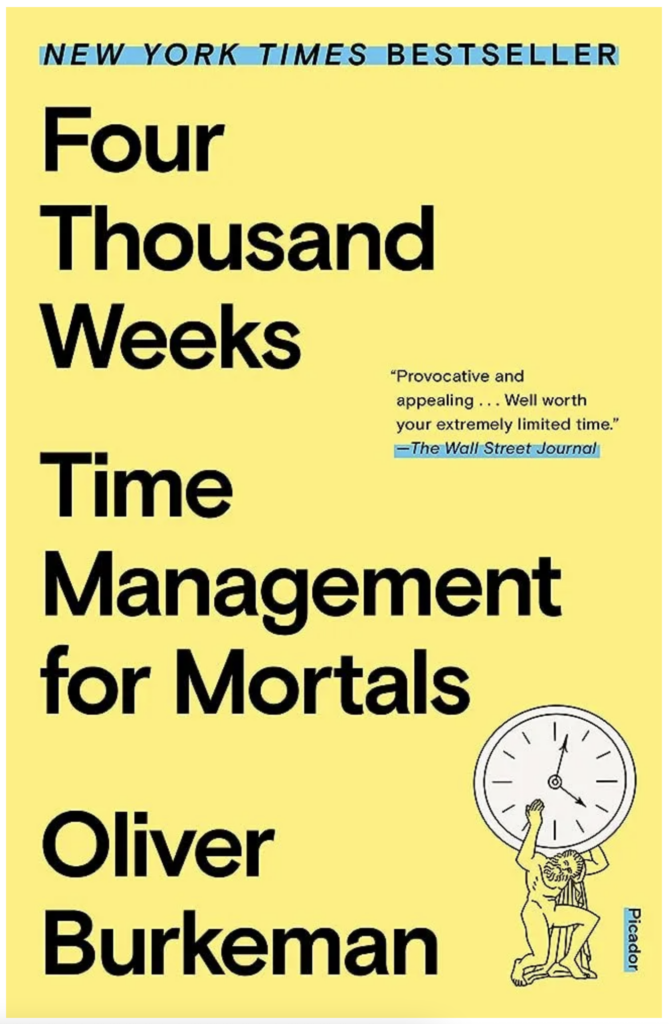
Time Management Mistakes – The Time Management Mistakes We’re All Making, according to the New York Times Bestseller “Four Thousand Weeks, Time Management for Morals” by Oliver Burkenman.
Parker Klein has summarized the following nine mistakes:
1. Are you trying to do more and haven’t decided what to focus on ?
“Time feels like an unstoppable conveyor belt, bringing us new work as fast as we can deliver old work, and being “more productive” seems to make the conveyor belt go faster.” — Edward T. Hall
When people make enough money to satisfy their needs, they simply find new things they want and new lifestyles they want. The real problem isn’t our limited time. The real problem is that we’ve unconsciously inherited it and feel pressured to live by difficult ideas about how to use our limited time, all of which are guaranteed to make things worse. Since hard choices are inevitable, it’s important to learn to make them consciously, to decide what to focus on and what to ignore, rather than letting them be chosen unintentionally.
Warren Buffet’s advice: Write a list of 25 things you want in life, then rank them from most important to least important. The top 5 should be the ones you make time for. The remaining 20 should be avoided at all costs, as they are important ambitions but not enough for you. They distract you from the core of what matters most in life.
The question you have to answer is, what are your top priorities?
2. You prioritize the future.
Instead of simply living your life as it happens, it becomes hard not to value each moment for its usefulness in serving future goals, or the future oasis of relaxation you hope to reach when your work is finally “off the table.”
“It pulls us out of the present, leads us to a life that is directed toward the future, to worry about how things will go, to experience everything later with anticipation. Peace of mind is rarely achieved. “We work each day more energetically and thoughtlessly than is necessary for our survival, because for us it is more essential not to have free time to stop and think. The haste is universal, because everyone is running away from himself.” — Nietzsche
The question you have to ask yourself is: How do you feel right now? What do you need to do right now?
3. You ignore your limitations.
No time management technique is half as effective as actually facing things as they are. When you’re convinced that what you’re trying to do is impossible, it becomes much harder to berate yourself for failing.
A time-bound mindset means organizing your day with the understanding that you will never have time for everything you want to do or that others want you to do, and at the very least, you can stop beating yourself up and setting yourself up for failure.
Technically, it makes no sense to feel overwhelmed by your overwhelming to-do list. You will do what you can do, you will not do what you cannot do, and that nagging inner voice that insists that you must do everything is simply a mistake.
When there is too much to do, the only path to mental freedom is to let go of the limitless imagination of accomplishing everything and focus on doing the things that matter, the things that should be done the most.
It’s not an incremental improvement, but a shift in perspective that reframes everything. When you no longer have to convince yourself that you’ll do everything you need to do, you’ll be free to focus on doing the things that matter.
The question you have to ask yourself is, what limitations have you avoided, and how can you accept them?
4. You seek happiness and experience.
Filling your life with satisfying activities is often less satisfying than you might expect.
The more you succeed in having great experiences, the more you begin to feel that you could have or should have more, in addition to the experiences you already have. The result is a sense of being alive that becomes more and more abundant. For to be alive, what is needed is the will to resist the urge to consume more and more experiences.
Because such a strategy can lead to the feeling that there is more experience left to consume, you will be able to focus on fully enjoying the little experiences that you have time for, and you will be free to choose what is most important in each moment.
The question you have to ask yourself is, what experiences can you let go of?
5. You don’t prioritize yourself.
If you don’t save yourself a little time now, every week, you will find that there is no time in the future when you will be able to do everything miraculously and have a lot of free time.
Give yourself some time first.
The only way to avoid wasting your free time is to focus solely on the satisfaction of the experience. It is to truly enjoy your free time, rather than converting it into self-improvement focused on the future.
Taking a vacation for the sake of taking a vacation requires first accepting the fact that your days do not progress into a future where the beginning of absolute happiness begins, and approaching them with such an assumption is systematically depriving our weeks of their value.
“Nothing is stranger in the modern age than laziness. How can there be play when nothing is meaningful unless it leads to something else?” — John Gray
We might try to incorporate more of the things we do for our own benefit into our daily lives – to spend some of our time on activities where the only thing we are trying to get out of them is the doing of them ourselves.
To be a source of true fulfillment, a good hobby can feel a little embarrassing. That’s a sign that you’re doing it for its own sake, not for a socially acceptable outcome.
The question you have to ask yourself is, what activities do you want to do to enjoy the present?
6. You get distracted easily.
The ancient Greeks said that distraction is a systematic, internal failure to spend time on the things we claim to value most.
What you pay attention to determines what is real to you. Your experience of being alive is nothing but the sum of everything you pay attention to.
When you pay attention to something you don’t particularly value, it’s no exaggeration to say that you pay with your life.
To have a meaningful experience, you need to focus on it at least a little bit. Can you have an experience that you don’t have?
Because the Attention Economy is designed to prioritize whatever is most interesting, rather than what is most real or useful, it systematically distorts the picture of the world we imagine in our heads all the time. It’s not just that our devices are distracting us from more important matters; it’s that they’re changing the way we define “important” in the first place.
The question you have to ask yourself is, what do you value most? What do you want to stop doing?
7. You have to keep up with everyone.
As the world moves faster and faster, we come to believe that our happiness or financial survival depends on our ability to work, move and make things happen at superhumanly fast speeds. We begin to worry about keeping up, so to quell our anxiety and try to achieve a sense that our lives are under control, we move faster.
Speed addiction is often socially glorified. Your friends are likely to compliment you on your “drive.”
Patience is the least powerful but perhaps the most consequential superpower.
In a world that’s driven by urgency, being able to resist the urge — to let things take their time — is one way to do work that matters, and derive satisfaction from it, rather than postponing all your accomplishments to the future.
We are deeply uncomfortable with the experience of letting reality unfold at its own pace, when when we are faced with a problem it feels better to race towards a solution. In fact, as long as we can tell ourselves that we are “managing” the situation, we maintain a sense of control.
The question you have to ask yourself is: What activities have you been doing? How can you be more patient?
8. You try to do too much.
Embrace the incremental steps: Focus on making small, consistent progress.
The most productive and successful academics make writing a smaller part of their daily routine than others, and are thus more likely to continue writing day in and day out.
The question you have to ask yourself is: What goals can you break down into consistent habits?
9. You don’t allow yourself to do one thing at a time.
“Your personal path is the path you make for yourself, the one I never set out for you, the one you do not know in advance, and it will come about by putting one foot in front of the other, quietly doing the next and most necessary thing. As long as you think you do not know what it is, you have too much money to spend on useless speculation. But if you do the next and most necessary thing with conviction, you will always do something meaningful and intended by fate.” — Carl Jung
The next and most essential thing is that there are things that all of us can do at any given moment, and we have to do them even though there is no objective way to ensure what the right course of action is.
Working within the constraints of your historical time period and your limited time and abilities, you really did it and brightened up life for the rest of us by doing it, whether you were here for a big job or a little weird thing.
The question you have to ask yourself is, what is the next most important thing you can do?
This book, “Four Thousand Weeks, Time Management for Morals” written by Oliver Burkenman is now available in Thai. The title is “Our Life Has Only Four Thousand Weeks.” You can buy it here: https://shope.ee/7pSPSGdUzy
Reference:
9 Time Management Mistakes You’re Making
Recommended articles:
To do list Formula – A formula that helps you manage your life well and have more time left.
