

Learn from experience , especially through our own experiences, whether it is through doing it or putting ourselves in that environment. It is all good in terms of gaining knowledge and also results in positive changes in our own lives.
Change starts from within
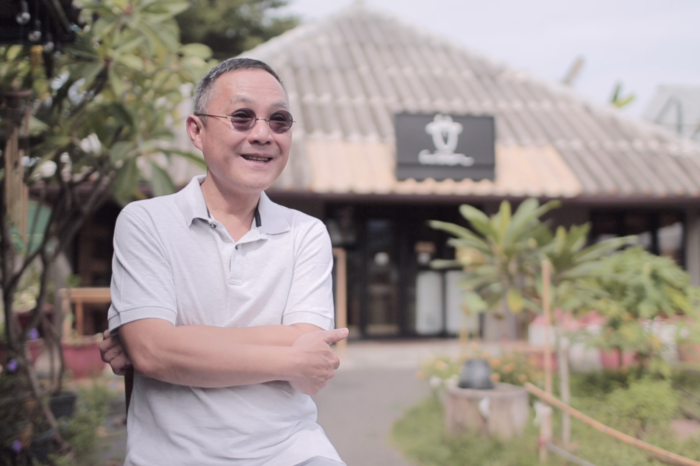
The life path of Mr. Wilit Techapaiboon should have been different because after graduating from Chulalongkorn University, he went on to continue his family’s large hotel business. But after working for about 10 years, he found out that it was not the way of life he wanted. Wilit decided to turn his back on his business life and start the life he truly wanted by doing organic farming according to the principles of the sufficiency economy along with doing social business, hoping to find a way to do business that did not aim for maximum profit, but focused on doing business that did not harm the environment and could coexist smoothly with society. The path that Wilit chose opened up opportunities for him to learn many things, including learning to realize that real change does not start with anyone else but himself.
Old world, new world
“I worked with my family until I was 33 years old. Around 1995, I thought it was a good time. So I gradually told my parents that I wasn’t going to be a businessman. I wanted to go out and learn new things. I wanted to go farm and grow rice. They allowed me because they thought I would only go there on the weekends. But I was gone for many years,” said Wilit about his past experiences, adding that starting out as a farmer with chemical-free mixed farming was very different from the businessman’s lifestyle. He lived a life of sleeping on the ground and eating in the sand, and there was no electricity to live a comfortable life. But that wasn’t new to him. Even though Wilit was the heir to a big business, his original interests were a combination of studying Buddhist practices and continuously studying the agricultural sector, so he was already accustomed to this inconvenient way of life.
“Actually, that wasn’t the first time I had to live by lantern because there was no electricity. There was a period when I graduated and was ordained as a monk at Wat Pa Ban Tad of Luangta Maha Bua Yanasampanno, which had no electricity. That was the time I got to live like a forest monk. In the morning, I went on alms rounds, in the afternoon I meditated, and in the evening I swept the temple grounds and carried water to the toilet. I saw an exemplary way of life,” Wilit said of one of his past learning processes.
Agriculture for learning
The time when Wilit went down to pioneer agriculture was the time when he learned from seeing the real problems of farmers. He saw the way of farmers who had to use chemicals, pesticides, and the problem of never-ending debt.
“Having met the villagers, I found out that farmers’ life does not come from selling their products. Their real life comes from the loan cycle. Farmers have to borrow money from the bank to continuously produce products every year. And each year, the bank lends more and more. So I wondered why we are just talking about having farmers keep household accounts now, when in fact, we should have taught them how to do it even before we wrote the national economic development plan 40-50 years ago. Because if you want farmers to have a good quality of life, you have to teach them the system first,” Wilit said of what he learned from interacting with the villagers during the initial stages of his life change.
Wilit has been interested in and has studied the agricultural sector for a long time before that. He joined the Local Community Development Institute under the leadership of Professor Saneh Chamarik, visiting many areas nationwide to study structural problems, which is considered a step of learning from doing, not just studying through textbooks.
“I was a student outside of school of Professor Saneh. I followed him to observe his work in various places. I learned about the real problems in the structure of the agricultural sector. This is the reason I wanted to do agriculture because I wanted to learn more about these things,” said Wilit.
Take action ‘Dhamma’
Since childhood, Wilit said that he had a variety of interests, most of which were outside the classroom. One of the things that Wilit was interested in studying and which greatly influenced his way of thinking was Buddhism.
“When I was a child, I had the opportunity to learn about meditation from a teacher who was a friend of my father. So I gradually absorbed this subject and he advised me to practice it because he thought it would be beneficial. At that time, I was probably around 10 years old and started learning about meditation. I learned about the principles of the law of karma. Part of it was just for fun like any other child, but part of it was to instill these things in me. When I grew up, when I had to make important decisions in my life, I would base my decision on this.”
A former student of the Faculty of Commerce and Accountancy at Chulalongkorn University compared what he learned from studying Buddhist principles with his university education, saying, “In Buddhism, I think it teaches us to know life from a broad perspective: life as a breath, life as a spirit, life with dimensions. When that happens, it is beneficial to our lives in many ways. On the other hand, the education system that I studied has a set of values, such as what to do after graduation, how much money to have, all of which are things that we create an image of success for ourselves, and we run after, running after them continuously, regardless of whether we succeed or fail. So I think that the broad perspective on life that Buddhism gives us is something valuable that will help us survive in difficult times.”
Integrating learning into application
From getting involved with farmers and doing mixed farming according to the Sufficiency Economy philosophy himself, Wilit Techapaiboon crystallized and developed a sense of being a change agent within himself. He therefore pushed for the formation of a farmer group called the ‘Phetchaburi Farmer Rehabilitation Group’ and joined with many other farmer groups to push for the Farmer Rehabilitation and Development Fund Act to solve farmer problems comprehensively. This work gave him the opportunity to learn many more things.
“I learned that we cannot design everything, but circumstances design everything. Everything in life has two components: the part we can control and the part we cannot control,” he said of his life experience. “The more we move and push things, the more we see our weaknesses, see whether we are really doing it for others or for ourselves. The important thing is to know that the real problem comes from ourselves. I found a very appropriate word: ‘The real enemy is ourselves.’ It doesn’t mean that we should hate ourselves, but it means the interaction between the inner world and the outer world, which cannot be separated. So if you want to revolutionize the outer world, you can’t avoid revolutionizing the inner world. At least these two parts must be done together. You may not have to wait until you achieve something before helping others. But I think it is about supporting and improving together.”
Learn from experience
From the combination of interests in both teaching and life, it is clear that Wilit Techapaiboon values having first-hand experience in things because he believes that knowledge gained from reading and listening alone is not enough.
“I believe that we must gain knowledge from accumulation, not knowledge from reading or listening, but knowledge from accumulating experience. What we accumulate will make us gentler, cooler, and more composed, which is a good sign. However, whether or not it will make people change in a beneficial or useless way depends on what is our motivation for existence.
“I think if we use experience to help us learn more than textbooks or just thinking by reason, it means that every moment, every minute, we hold onto the principle of the foundation of mindfulness to determine and know various things. Even though it may seem far away, if we start to respect that experience, it will become something very close to us. Accepting this experience naturally is the common sense of existence. If we understand it that way, then we ourselves will be like having a mirror that reflects us all the time. It will reflect every image we experience. And we cannot avoid having to use this principle, which is the principle of vipassana in Buddhism. But learning can be both vertical and horizontal. Vertical means that we learn from teachers who have learned before. But it is not blindly respecting them because when we know that there are wise people who can do it, why would we not accept them as our teachers? Or, to put it another way, let them be good friends. As for horizontal learning, it means learning from our friends who we see here. Helping each other is also a part of reflection because smiling faces, suffering, and stress are also mirrors that reflect the nature within us.”
With all these learning methods, it is clearly reflected in what Mr. Wilit Techapaiboon thinks, believes and does.
The story references an interview with Mr. Wilit Techapaiboon.
From the Transformative Learning Project
Supported by the Health Promotion Foundation (ThaiHealth)

For more articles about the Transformative Learning Project, please visit:
Joan Jandai’s bad experiences are another teacher who gave us the hardest lessons.
Miao – Pilanthan Thaisruang learns through working with people and communities to bring out their potential.
