


Gender Equality is a very important issue in this era. Both government and private sectors, both domestically and internationally, have come out to campaign and support this issue widely.
We shift World change program, we adjust the world to change, special episode SDGs talk, this episode will talk about Sustainable Development Goals (SDGs) number 5, Gender Equality. Although this topic has been debated and fought for a long time, the changes that have occurred are not enough to allow everyone to have truly equal rights.
In this topic, we listened to the views of 3 guest speakers: Ms. Wanitchaya Kantayawong, Board Member of the Indigenous Women Network of Thailand (IWNT), Assoc. Prof. Dr. Chananarong Phunrungroj, Chairman of the Promotion of Shared Values and Social Responsibility Committee, Pranda Jewelry Public Company Limited, and Ms. Kate Kraengpibul, Lecturer at the Faculty of Social Administration, Thammasat University. All three guest speakers are personnel who help push for equality to the best of their abilities because they want to see Thai society as an equal society.
What is Gender Equality?
Gender equality, or the equality of all genders, whether male, female, or other alternative genders, must be social conditions, practices, and decisions that are equally accessible to all genders without discrimination.
The present that has been passed down from the past
Professor Kate said that the demand for gender equality has changed at this time because it is not just a demand that women and men are equal, but it is a demand that all genders are equal, including alternative genders.
But what our world has had for a long time is “culture”. It has been instilled since our ancestors’ generation and has been passed down until we see it as normal. For example, the idea that the father must be the head of the family, the head must be a man, etc. Every time someone starts demanding equality, there is always one gender who has the most advantage in that situation.
“Our country is a welfare society, not a developed society.”
From Chanarong’s business perspective, he said that the company has more disabled employees than the law requires. There are more than 70% of all employees in the company who are women. The company has a policy of hiring employees in this format because it sees the capabilities of women and the disabled. The equality that the company treats everyone equally makes it see potential that is more than gender or more than having 32 complete body parts.
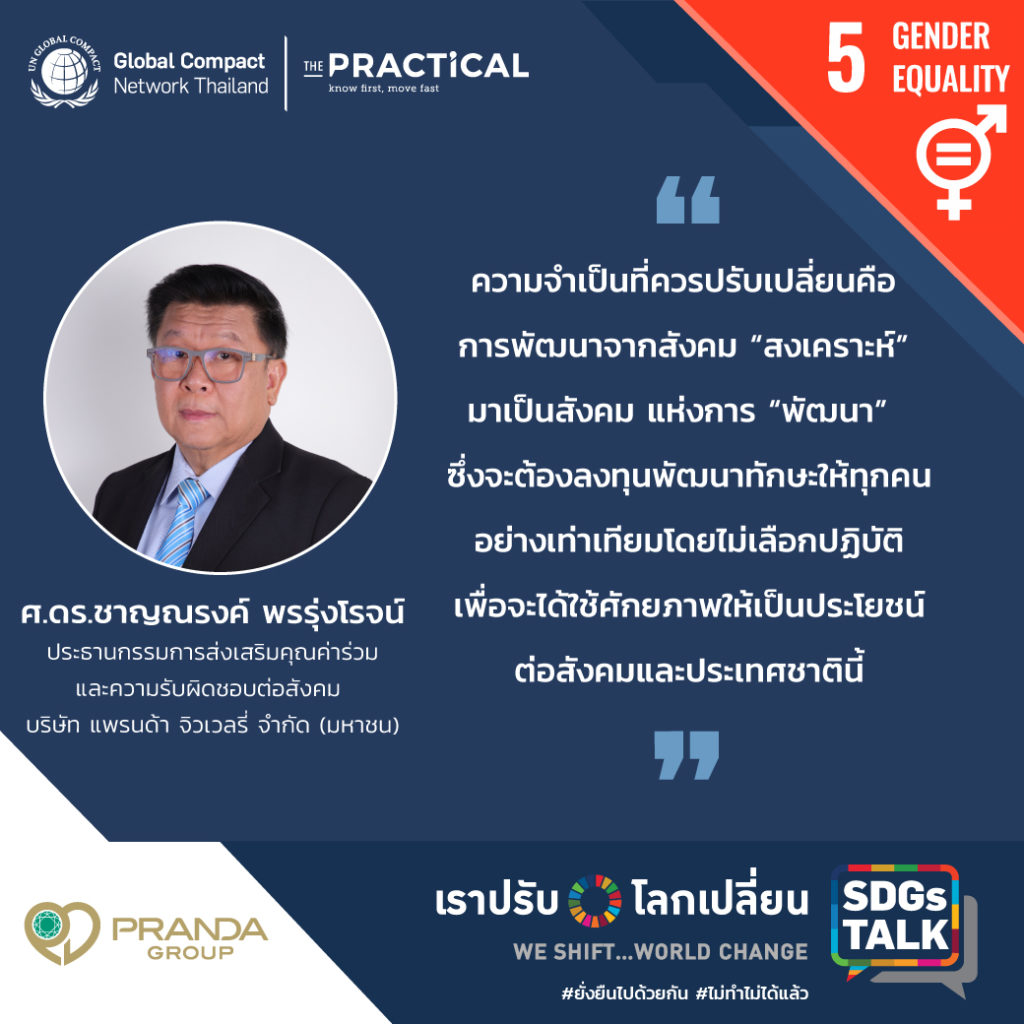
He continued that originally, Thai people were divided from the beginning of education. There were all-boys, all-girls schools, disabled people, and then divided into good students and bad students. Therefore, discrimination occurred. Especially for disabled people, instead of receiving a good education, being able to develop and be in the real world, they were separated and waited for assistance. Therefore, most disabled people did not have access to real education and development. The result was that they could not show their true potential.
“Culture makes people shut out of their identities.”
Finding gender equality is difficult, but there are also cultures, traditions, and customs that are sometimes difficult to touch. Ms. Wanitchaya said that for the 15 ethnic groups that are far from development, many tribal women still suffer from the issue of male dominance because of the inherited traditions. For example, only men can perform rituals. Even if there is violence within the family, women have to choose to endure it just because they want to participate in the rituals. The same goes for equality for alternative genders because the culture, traditions, and rules of each tribe often block the true identity, making it impossible to be what you want. And it is not easy to change the rules and traditions in a short period of time.

“I dress badly and don’t speak clearly. When I walk into a shopping mall, they think I’m dirty.”
It would be quite depressing if the clothes we wear, the language we speak are looked down upon, or when we need a service but we are discriminated against, ridiculed and humiliated. It would not be a happy thing if a person has to go through such a situation.
What is currently going on?
Mr. Chanarong said that the company now has a company policy regarding non-discrimination. There are female security guards to be able to monitor female employees. There are both separate and family dormitories. There is a childcare center for employees’ children. Scholarships are provided. In addition, for the disabled, there is job training that suits each person’s potential.
“If his life is happy, he is ready to work hard. This is worth it.”
Because most companies see these things as additional expenses, but in fact, they are worthwhile investments. Because when they start to be happy to work with us, they will show their full potential. And it’s never in vain. For Pranda, some employees stay with her for two or three lifetimes because the company provides them with equality like a family, a life.
How to balance income and opportunity
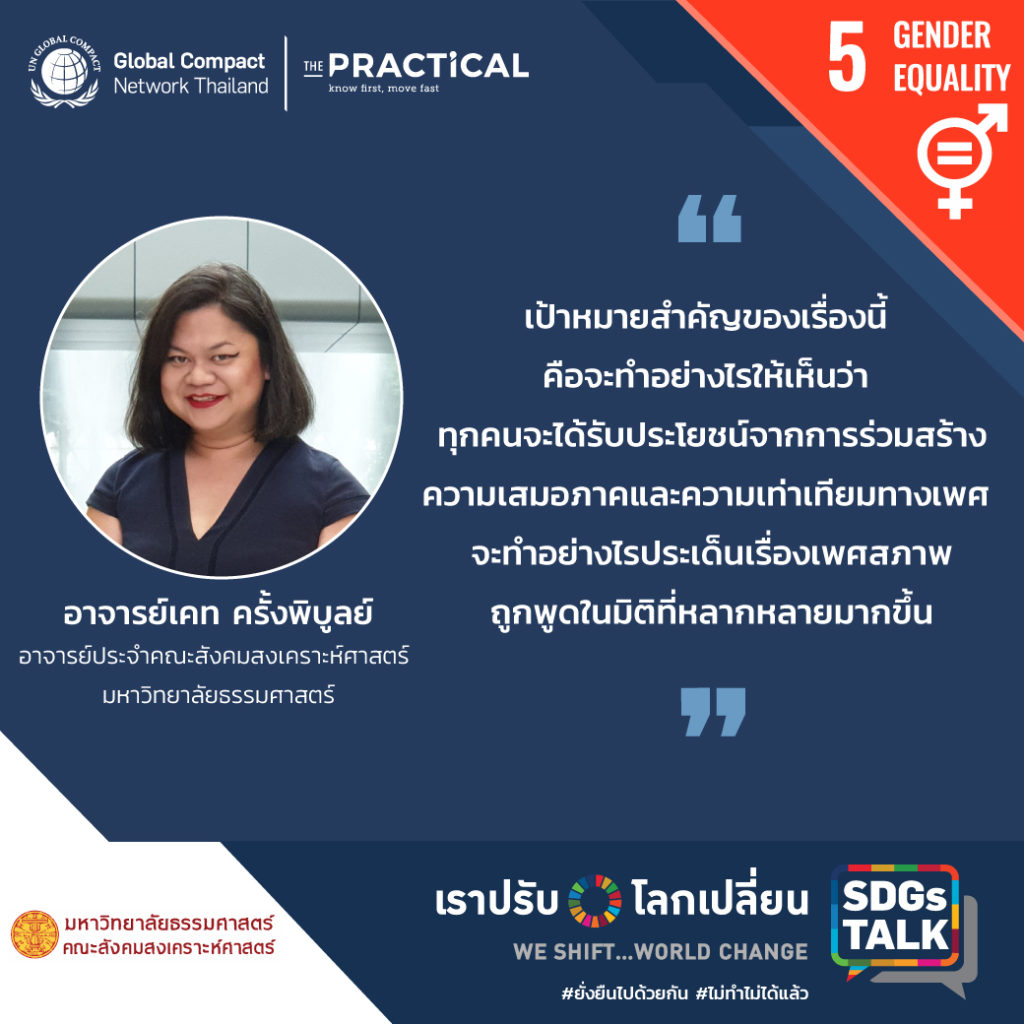
There are many changes now. In fact, in the past, only men were interested in studying or doing jobs. Now, there are more women. Academics are talking about how to achieve equality even though the gender ratio is close to the same. For example, in a classroom with 30 men and 50 women, why is it that the class president is usually a man?
“Women have many opportunities, but few opportunities to be promoted.”
Professor Kate revealed that even though women now have more opportunities to work in the same roles as men, there is still a balance in income because with the same salary, women have higher expenses called sexual costs, such as sanitary pads, which was a controversial issue for a while because sanitary pads are something that women have to use a lot every month and are quite expensive. But women still receive the same income as men who do not have sexual costs in this area.
“The person who needs to have knowledge and understanding to be able to protect themselves is yourself.”
From Wanitchaya’s perspective, everything is even more difficult when we are tribal women. Even though there are currently laws on gender equality, laws protecting the right to be discriminated against, or agencies promoting equality, when something really happens, help is too far away to come to help. Because the pain will have already happened anyway. This is the reason why Wanitchaya is trying to push for the provision of knowledge about the violation of tribal women’s rights, so that they have knowledge, understanding, and can protect themselves until help arrives.
Conclusion
Because you never know when you yourself will become someone affected by inequality in society or you may be taken advantage of without knowing. Try to change your attitude, see everyone as an equal human being, accept each other’s differences. Because if everyone in the world is the same, there would be no such thing as specialness. If you are someone who has received an opportunity and we can pass it on, do it. Just have a good attitude and pass these things on, it is considered as giving opportunities to those who cannot reach them.
Because no matter how much, how much, or how little, everyone is still the same person. Respect the humanity of others as much as you respect yourself.
….
“We Shift…World Change” program
Episode: “Changing Perspectives on Human Rights”
Or you can choose to listen to the program in Podcast format at:
Follow the program “We Adjust…World Change We Shift…World Change” on Facebook
via Facebook page @ New Generation Salaryman or Facebook Global Compact Network Thailand and The Practical’s Social Media channels.
