


Active Listening Listening is a big problem because people nowadays listen less, which causes problems in communication and collaboration. Listening is an important skill that employees should have because listening with the heart or listening attentively will make the listener understand what the other party wants to present.
When someone talks, there must be someone listening. Listening to other people’s stories from conversations in normal situations is like receiving specific information for free. But sometimes, to listen to someone talk about something we want to know, we may have to pay a lot of money in exchange for that information, such as attending training courses, listening to lectures, etc. So how do we make our listening worthwhile, complete, and most beneficial?
This Active Listening Techniques book can help. It will help you use face-to-face communication effectively to better understand people’s reactions and convey your message more effectively.
Nixaly Leonardo is the author of this book. She created this listening tool called Active Listening Techniques to help everyone, whether they are speakers or listeners, to be active and enjoy listening to others talk. And importantly, it is not only beneficial to the listener, in the context of the person speaking, when they are listened to attentively, it is also considered respectful and dignified, which can help reduce the problem of miscommunication or misunderstandings. The tools and methods in this book will help everyone to listen more intently to each other.
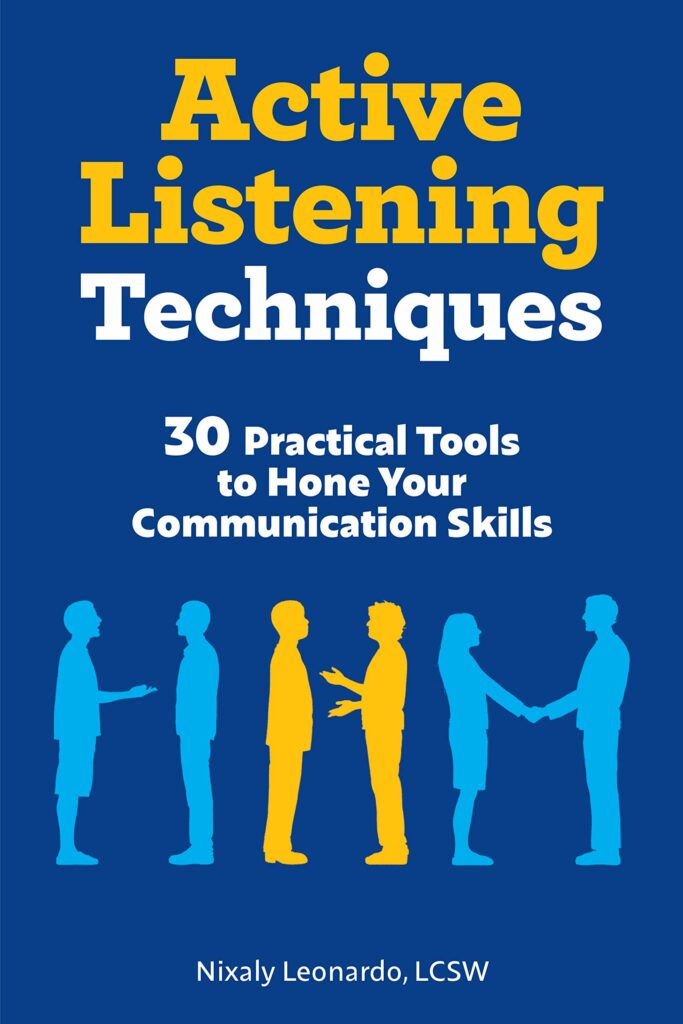
“Active listening is a better and easier way to communicate.”
The concept of active listening may sound simple, but it is quite challenging and technically different from everyday listening. Active listening means being fully aware of what the other person is saying, listening with an engaged body and mind, and responding to their message as it is being conveyed to us. Active listening helps us to understand the speaker’s message and makes them feel good about having us as a listener.
“Distorted Communication in the Digital Age”
Through active listening, we allow others to express their feelings and opinions freely. Perhaps you have experienced problems or misunderstandings in your digital communications, whether it’s a social media post or a work email. Active listening involves reaching out to others by understanding their needs. Learning this skill will allow you to connect more authentically with others and reduce the risk of communication distortions.
Active listening is a combination of analytical, reflective, and passive listening. Each type of listening is described below.
- Critical listening is the most demanding because it involves a judgmental process of calculating what is the point of the message being heard, what is true, and what is just the speaker’s opinion. Once you have gathered information, processed it, and developed your opinions, you can then listen to the conversation that follows with a critical mind.
- Reflective listening: This type involves using your words to act on what you have heard. Reflective listening does not require you to analyze or judge the speaker’s words, but rather lets the speaker know that you have received and understood his message.
- Passive listening, as the name suggests, is a form of listening that does not involve any action in the context of the listener. Sadly, it is the most common type of listening. Most people listen passively, only paying attention when it is time for them to speak.
“You can’t really listen to someone and do something else at the same time. If you do, you’re just listening.”
Passive listening means that you pay attention to someone’s voice without intending to respond to their message. Active listeners are the best people you want to have in your audience. They use essential listening skills to interpret messages, judge the speaker’s emotions, and observe the speaker’s physical expressions. They also engage in reflective listening to help the speaker feel heard.
“No one communicates well on their first try, and it’s common for everyone to make mistakes in this area.”
Active listening is valuable for any speaker, but not everyone who speaks is an active listener. Everyone should learn to be an active listener because effective communication helps you perform better in the workplace. However, remember that no one is born a master of communication. Accept this conclusion as a starting point for learning. Every good communicator has failed at some point in their lives.
“Your life will be happier when you learn to communicate well.”
Learning to improve your communication skills is important and will save you from many personal and professional problems. Everyday life experiences Everyone has been in a position where you know you want to tell your boss, co-worker or partner something, but just don’t know how to say it. Many people use silence in such situations, which only makes the problem worse.
“Active listening is an element of empathy.”
Empathy is the key to being a good listener. According to Nixaly Leonardo, empathy is “the ability to sense how another person is feeling and imagine what it would be like to be in their shoes.” Without empathy, we hear what the other person is saying and ignore them. We don’t understand them, so we can’t respond to their needs.
“Generally, when people feel heard and understood by you, they tend to be less angry about what you do.”
Listening also makes it easier to criticize your coworkers and subordinates. Imagine a boss who is always there to listen to everything you have to say. Their actions show that they are not only interested in getting results, but also in your professional growth and well-being. If such a boss gives constructive criticism of your work, you won’t feel bad about him at all, because the fact that he listens to you all the time proves that he is doing it out of good will.
Developing the ability to manage your strong emotions during an argument is another benefit of active listening. You can use these two communication techniques to manage your negative emotions.
- Interpretation : When you interpret what you have heard and then explain to the speaker that you understand what they are saying in this way, it is very good because if your interpretation is incorrect, the speaker will have the opportunity to correct your understanding and you will get a clearer message.
- Body Language : Body language is any means of communication that does not involve words. When the listener uses body language, such as body movements, gestures, and eye contact, it makes the speaker feel important. Conversely, when the speaker uses body language cues, it enhances the meaning of the message they are trying to convey.
When you use interpretation and body language together, you help the speaker feel more understood and connected to you. As a result, they will be more satisfied with your interactions.
“If you find it difficult to listen well, look at your obstacles and eliminate them.”
There are many reasons why people don’t listen as well as they should. Identifying these reasons can help you become more aware and help you become a more empathetic person. Authors Richard West and Lynn Turner have grouped the obstacles to good listening into four categories:
- Physical noise, caused by external sounds, such as opening a door.
- Physiological noises caused by illness, biological defects, or joint problems.
- Semantic noise, from difficulty in understanding the speaker’s speech due to the jargon used or inappropriate grammar.
- Mental noise, which is caused by mental and emotional factors
All of the above can act as stressors, making it difficult to focus on the conversation. Try to identify the people who are constantly getting in your way.
“Most people scroll through social media more often than they interact in person. If that sounds like you, it might be time to cut down on your phone and double down on in-person communication.”
When dealing with someone who seems distracted or unfocused in a conversation, you may need to address their emotional needs first. Start by listening to them talk about themselves. This will clear their mind. Then use empathy and body language to show that you are genuinely interested and interested in what they are saying. If you can’t quiet the noise around you, then mental silence won’t matter. Technology is one of the biggest barriers to quieting the noise around you and impairing your ability to interact in person.
Sharpen your communication skills to become a more active listener.
Every time we come into contact with people, it is an opportunity to boost or hurt our self-esteem, our perspectives, or our interpersonal relationships. So, we should improve our communication skills by understanding ourselves better, recognizing our biases, and managing negative emotions. Here are some tips and methods to help you do just that.
- Challenge your distortions : You can challenge your distortions by focusing on the negative, automatic beliefs that are occurring momentarily and immediately deciding to align those beliefs with reality. Use compassion to recognize when you have negative reactions.
- Manage Your Expectations : We all have expectations about the people around us. We need to learn to manage them, especially the unrealistic ones, to become better listeners.
- Practice mindfulness : Mindfulness involves being aware of the sounds, their meanings, and their impact. Practicing mindfulness helps you to be present in the moment and become a stronger listener. It also helps us to realize that no one is immune to negative emotions and stress. A non-judgmental attitude makes us better listeners.
- Practice emotional self-control : Dealing with intense emotions can distract you and distract you from your focus. However, you can avoid these effects by training yourself to be intentional about how you deal with your feelings.
“We have to give them what they want.”
Persuasion is a powerful communication tool that works for everyone. If you want to get someone’s attention, all you have to do is put them first. Putting the needs of others before your own will make them feel indebted. We all have needs to be seen and heard. Many people don’t feel like they’re getting these needs met. Imagine what happens when you become their savior.
Conclusion
Active listening is simply a way of listening that involves being mindful of your participation when a message is being conveyed and the person is speaking to you. You can practice being a good listener by recognizing your barriers. Whatever is getting in the way of your active listening, preventing you from being able to focus on listening, become familiar with them and practice being patient in those situations.
Also, every conversation starter must have a purpose. We can start a conversation with anything from relaxation to negotiation, but you have to choose it wisely. Understand the person you want to communicate with. If you need something, give it to them first, and they will give it back to you.
“People who can actively listen to others know the best and easiest way to talk to others.”
