


Designing Your Work Life Design your own work life, not let your work design your life.
The author has applied the principles of Design Thinking to present them for use in designing our own work lives, not letting those jobs design our lives. What are the stories and methods? Let’s find the answers from the book Designing Your Work Life: How to Thrive and Change and Find Happiness at Work.
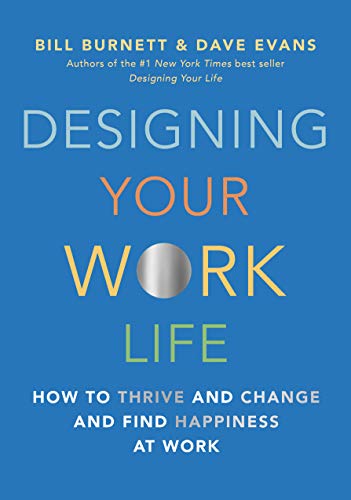
Most of our lives are spent working. In a week, our working hours may be more than our total leisure time, or maybe it has been more for a long time. Therefore, it is not surprising that the workplace has become the place that has the greatest impact on our lives. The next thing to look at is the impact it has created, is it a positive or negative impact on us?
The book Designing Your Life by Bill Burnett and Dave Evans is like a guide to help us design our own lives to be satisfying in our own way. We can create the life we want. It is like being a designer of our own clothes. We design our own clothes. What color do we like? Skirts or pants? Dresses are short or long? We choose. If we can design our clothes, houses, buildings, why can’t we design our lives to be the way we want?
“Design our work to become the work we want.”
When we reach a point in our work where we feel miserable, bored, or exhausted, at that time some people may feel that it is normal and choose to endure it. Some people may feel that they cannot handle it, to the point of having to choose to change their life path by resigning. But one thing that many people have never tried is redesigning the work, adjusting or changing it to match our work satisfaction.
“Money is important, but be careful, if you focus too much on money, it may not meet your goals and the meaning of your life.”
At the beginning, there are always obstacles to the idea of designing work. The obstacles are so valuable that many people choose to throw away the idea of designing their own work. This obstacle is money. Compensation such as checks that we can cash, the amount of money in the account, or valuable banknotes. What we have to do is compare and weigh the value of those things with the meaning of life and work goals. We will see clearly what is more valuable to us?
“It might be good enough for now…but not forever.”
How often have we wished there was some magic or miracle that would make our current workplace better? Or that our boss had a better personality? What we end up doing is telling ourselves, “This is good enough,” or “This is good enough,” when in reality, what we should be doing is creating that magic ourselves. Because saying, “This is good enough,” doesn’t mean that we can’t be better.
“What we have to do is make the best of a bad situation.”
The horror of our “good enough” mindset. This kind of thinking frames our ability to perform well because we think it is already good enough. As a result, learning and growth are very difficult to achieve. In fact, our potential is only truly tapped into when we are in a really bad situation. So bad that the word “good enough” no longer applies. So doing our best in a bad situation is a way to enhance our abilities and show them cleverly, which makes us stand out in the moment. But wouldn’t it be better if we didn’t do our best only when things were bad? That we could do our best in every situation?
“We need to clarify our work and life perspectives to avoid falling into a path that is not right for us.”
In terms of designing our own lives, our perspectives on work and life are like the starting point that leads to what we want. Income is often the main goal of work, while life still needs meaning in existence. Many people are obsessed with materialism, money, and power, which makes them neglect their goals or meaning of life. The path to a satisfactory life is not smooth, and often leads us to the wrong path. In reality, between money and the meaning of life, no one can correctly answer what we should choose. Because money and the meaning of life have different indicators in terms of giving value, and these two things cannot be in the same question. What we need to make clear to ourselves is to create a compass for our own journey to adjust our perspective to be clearer, as follows:
- Work Perspective : Setting a work perspective is like declaring what we have set for ourselves about good and bad work. Why do we work? What do we work for? What does work mean? And how does it relate to ourselves, others, or society?
- Life Perspective : As big and scary as it sounds, it’s our initial idea about what gives meaning to life and how to live it well. It helps us prioritize what’s most important. We can start by asking ourselves questions like: Why are we here? What is the meaning and purpose of life? What are our personal relationships with others? And which family, city, and place in the world is right for us?
“Put the problem in the box and tell me what’s in the box.”
The next thing in designing our lives after we have discovered our own perspective on working and living is to restructure to solve new problems that we have never dealt with before. Every time a problem comes up, we pick it up and put it in a box and say what is it? This box becomes the frame that we limit the space for those problems. But in solving new problems, it is not about what problem is in the box, but the box is the problem.
We often say that creativity is thinking outside the box, thinking outside the box we put our problems in. It’s all about playing around with our boxes without jumping inside them. But this kind of play only happens when…
“We have to accept that there is always a box, no matter how far we go, and remind ourselves that the problems we are facing and trying to solve always have a box to put them in.”
The solution is that when we know that we have a box for the problem, we can change the size of that box whenever we want. Enlarging the box increases the space for solutions that we can use to solve our problem. But what if we ask why we don’t unpack that box when we already know that the box is there? But as humans, we can’t do that because the box will be there. No matter how much we expand it, it will still limit our thinking.
“We will find that it is not entirely accurate to say that others are taking us further and further away from happiness.”
When we are stuck in a life that we are not happy with, we tend to blame or shift the blame to other things around us. “It’s not my fault that my job sucks. Have you ever met my boss?” or “It’s the company’s bad policies and culture that makes all the employees so unhappy.” We keep saying who or what is the problem, but we never say it’s ourselves. We may be blaming our terrible boss for making us so unhappy at work. But have we ever asked ourselves who is really our boss? Because in designing our lives, we are the boss.
“Change the story, change the outcome.”
According to research by Professor Carol Dweck of Stanford University, we can divide people’s minds into two types: the first type is a group with a fixed mindset and the second type is a group with a growth mindset. People with the first type believe that their talents and abilities are fixed. By nature, talent cannot be changed. When they succeed in something, they believe that it is due to their natural abilities.
“It’s not my fault, I’m just not good at those things.” Many people say this when they fail.
On the other hand, growth mindsets choose to believe that while everyone has different natural talents or abilities, talents and abilities are something that can be developed. They can learn to be good at new things. They believe that success can be achieved through hard work and practice, and that these things are not something that they are born with.
“People who have a growth mindset are willing to work hard to achieve their goals, even if they are not talented to begin with.”
These are 2 things in the world that make a difference. Look at your own story. Whenever you feel like you are becoming a fixed-minded person, try to restructure your thinking and tell your old story with a new and better way. Try to bring in growth mindset, look back at yourself, create and push for change to solve the problem by expanding the frame that you have set a bit wider and it will be better.
Redesigning your work life may not be easy, but it’s a lot easier than starting over. So at the very least, let’s try to understand how we design our work life and try to follow these ideas before we rush into quitting. Here are two strategies that will help us expand our boxes and not be stuck in old boxes.
Strategy 1 : Restructure and Change the Rules – Reshaping your routine around organizational priorities, adding more value to your operations. Even if you’re still working in the same place, tweaking your routine or trying to set new rules and stick to them can create different stories and build relationships in ways you’ve never experienced before in the workplace.
“Look for new benefits and find a source that will give you enough satisfaction…for now.”
Strategy #2 : Reinvent the Model – We can overhaul our work life, making visible changes. A new image, new carpeting, new furniture, and it may sound like we need to change it all. Changing the model we use to do our work is something bigger and more engaging, and can make a bigger difference.
“It’s a great opportunity for us to start writing a new chapter and story of our lives.”
At the point where we design our lives, we realize that it is better to start over than to try to design a new job in the same place. There is nothing wrong with that because resigning is one of the life designs that we have chosen. Many people always have negative thoughts about resigning, but actually resigning presents a good opportunity. It makes us see the truth between finishing something and starting over. We should reframe resigning as an opportunity for you to become a writer and start writing your own story again.
Conclusion
Life is already difficult by itself. If people already have a perfect life and a stable job, we wouldn’t need to design our lives any further. But in reality, it’s not like that because stability doesn’t really exist.
“The design of our lives has no end, and it is not perfect. But sometimes it is very good, because our lives are short, too short to stop working, and our lives are too precious to stop working.”
Designing our lives is like a work in progress. There is nothing better than not knowing what will happen next. It makes our lives endlessly interesting, exciting and fascinating. Sometimes we may fail, fall back, or have to start over again. But with design thinking, we become immune to failure. We will have the strength to move forward again, to find moments of success that may even be more than we ever imagined.
