


Effective Decision-Making is about making decisions. In our lives, we have to make decisions countless times. We make more than 10 decisions per day. In terms of making decisions, some things seem as easy as peeling a banana. For example, in our daily lives, deciding whether to take a motorcycle taxi or walk to work as usual, but if we have only 10 minutes left and are at risk of being late, it would not be difficult for us to choose which method will make us get to work on time. Or the universal problem that occurs every day and is too difficult to decide, such as “What should I eat?”
Making decisions quickly, carefully, and with desired results is not easy. As we all know, decisions always determine the next situation. For example, when we have to choose between eating pork leg rice for dinner or skipping dinner? If we choose pork leg rice, we may go home and continue to worry about whether our weight will increase or not. We may have to wake up early to exercise the next day. But if we choose to skip dinner, we may have stomach pain from gastritis the next morning and may have to go to the hospital.
“We don’t need months or years to learn how to make good decisions.”
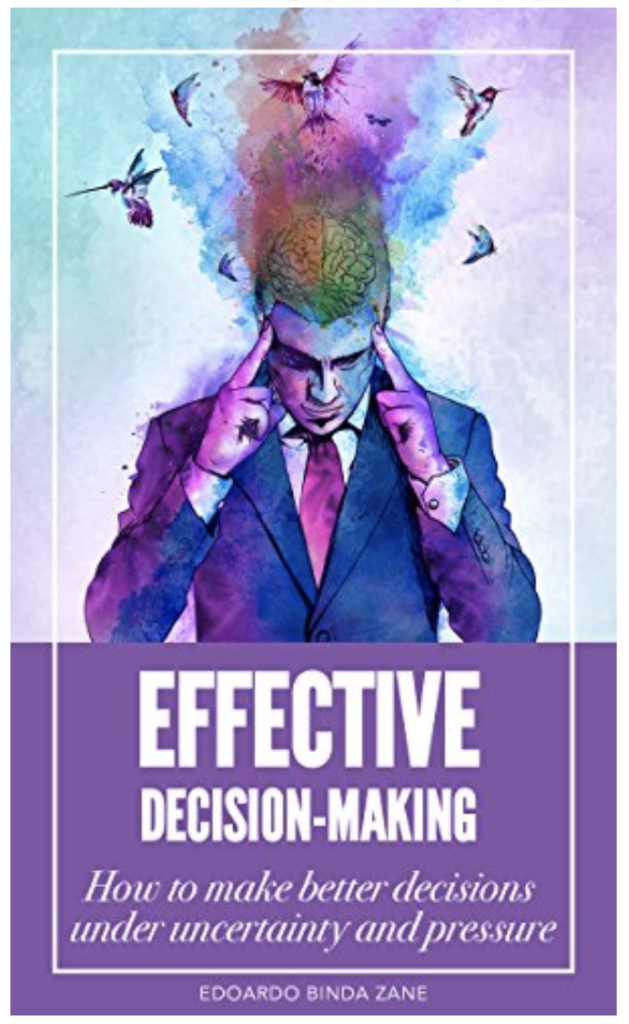
Effective Decision-Making: How to make better decisions under uncertainty and pressure is a book written by Edoardo Binda Zane. He has written this book with the intention of helping us make better decisions quickly, even when we are under unprecedented pressure or uncertain circumstances. The book will tell us with detailed steps and the best techniques for making decisions. This book will leave you ready when the next decision comes.
“Decisions are the seeds of success.”
We live in a fast-paced world, and we are used to the convenience and speed that we enjoy. But everything has its upsides, and there are also downsides to it. In this fast-paced life, the world demands quick decisions to keep up with its rotation, especially when we are working in a job that requires management, administration or control. Quick decisions and the need for the best results often challenge us more often than ordering food online.
“To get into a good position, decision-making is very important.”
Faced with situations where we have to make decisions on the fly, we are smart enough to know that good decisions are harder to make when under pressure. But since business is something we can’t slow down, what do we do? These concerns arise frequently in business, so we need to make sure we make the best decisions at the right moment that will produce satisfactory results. Here’s what we need to learn:
- 4 different frames of reference for decision making
- Strategies for setting and achieving goals
- SWOT & PEST Analysis and How It Can Help Our Organization
- 2 Additional Strategies for Finding the Root Causes of Business Confusion and More
OODA Strategy
“Careful observation and time to think things through will help you make good decisions.”
Creative observation and learning all we can about the business or industry in which we work can make us better decision makers. Take for example the military decision-making strategy for air combat called OODA , which stands for Observe, Orient, Decide and Act. It was designed by Colonel John Boyd.
“What you have to do when you observe is to draw on the facts around you.”
The observation step requires you to be aware of the circumstances of the event to determine whether you are in the right place and the right place. For example, if you are in a boardroom, you can observe the reactions of each meeting member. Is there a new person joining the meeting? What does their face tell us? Is the atmosphere in the meeting tense? Etc.
RPD Model
Recognition-primed decision model (RPD) In the decision-making process, we compare all available options and create a mental picture of the possible outcomes. Then we proceed to act on the decision and completely cycle through the OODA method . This is called the Recognition-primed decision model (RPD).
“RPD models are only useful if we have faced the same problem or similar problems in the past.”
This decision-making model was developed by Gary Klein in 1989. It is a common strategy that you may have used without even realizing it. Cognitive decision-making models involve thinking about a problem and drafting a solution based on our skills and past experiences.
“The achievement of our goals is not as important as the growth we gain in the process.”
Once you have set your goal, analyze your current situation and choose the option that best suits the obstacles you face. Always be aware of the possibilities and outcomes and choose the option that is most likely to produce the outcome you want. This will lead you to your desired outcome by asking the question: What do we do? Considering all the factors at hand.
PDSA Cycle
This cycle is common in most healthcare systems and is an effective and well-structured strategy, but it takes a long time to achieve success.
- P stands for Plan, which is the systematic design and planning of how work is to be done.
- D stands for Do, which means taking action according to the plan that has been laid out.
- S stands for Study, learning through doing.
- A stands for Act, which means to make changes based on the learning outcomes.
“If there is no action, then we have not truly made a decision.”
Business owners make use of analytical tools to make better decisions. We too need to be careful when making business decisions. Some decisions can be serious enough to cost us market share. If they do, it can take years of hard work and a lot of money to regain the position that our competitors hold. Sadly, some businesses never recover from their mistakes.
SWOT Analysis
It is a tried and tested method for analyzing business decisions. Considering every business decision, there are external and internal factors involved. When we consider these two factors critically, it becomes the key to success for us and the organization.
Internal organizational factors
- S – Strength: Analyzing strengths that are well-made or factors that promote differentiation and create business advantages, whether it is an organization, products and services, or the work of a team, etc.
- W – Weakness: Analyze the weaknesses that put the business at a competitive disadvantage and devise strategies to correct the weaknesses found to turn them into strengths.
External factors of the organization
- O – Opportunities: Finding ways to discover business opportunities that will positively impact operations, generate more income and profits. Opportunities are external factors that occur on their own and tend to change over time. Following news or trends around the world is therefore very important in order to have enough knowledge to predict future trends and also help us prepare strategies to create opportunities for the business most effectively.
- T – Threats: Anticipated negative business impacts from external factors, whether direct or indirect, that pose a risk of disrupting operations. If the business is not well prepared, it risks serious consequences, such as disrupting operations or shutting down.
“The more we understand our strengths, the broader our opportunities will be. At the same time, the more threats we identify, the clearer our weaknesses will be.”
Analyzing competition and profitability is essential to maintaining a healthy business. Many of the decisions we make will depend on the nature of the market or industry we are in. For example, Apple and Samsung are major competitors in the mobile technology space. Samsung’s Galaxy and Note models accounted for most of the decline in iPhone sales over the past year. Because of this competition, both companies are very careful in making production decisions, as decisions that could result in one of the two companies losing market share to the other.
In a competitive environment, here is a tool that can help us. It is a strategy called Porter’s Five Pressures, named after its developer Michael Porter. It is a tool to analyze the environment and competitive factors of a business as follows:
- Level of competition: The more competition there is in an industry, the less profit there is, and the less competition there is, the higher the chance of high profits.
- Threat of New Entrants How easy is it for new companies to enter your industry? Very easy? Then we need to tighten our belts and get smarter, or we will start losing.
- Bargaining power of buyers If buyers have multiple options, they have the power to influence prices. Every businessman knows that this is not a good thing.
- Bargaining power of suppliers Manufacturers also influence prices. The level of specialization of manufacturers and the difficulty of changing manufacturers all affect the bargaining power of suppliers.
- Substitute Products If we view the purpose of business as ‘solving problems for customers’, we must understand that one problem has many solutions, and the pressure from substitute products is the ‘ease’ that customers can find other products to replace their problems instead of using our products.
“Regular situation analysis is the best way to keep up with the ever-changing trends in our industry.”
Finding the root cause of a problem is the key to problem solving. There are two additional techniques we can use to find the root cause of a business problem.
- The first technique is called “Fishbone Analysis.” The basic idea behind this technique is to break down the root causes of a problem into categories so that we can focus on generating appropriate decisions and solutions until we figure out what our problem is.
- The second technique is called the “5 Reasons” technique, developed by Japanese inventor Sakichi Toyoda. It is a simple technique that involves asking five reasons before reaching a conclusion. Asking the answer and asking why again until you reach the fifth answer.
Conclusion
When there is a problem to solve, start by making sure we are comfortable enough to think straight and clearly. Our bodies and minds should be at their best, meaning we shouldn’t make serious decisions when we are exhausted or dealing with intense emotions.
The next thing to do after making sure that we are in the right state is to study the problem at hand, look at all angles before coming to a conclusion. It is important to listen to everyone’s opinions in the team if you are making group decisions. If we are the leader, we must make everyone feel confident and comfortable before the decision starts. Our brain, and if we do not know how the brain works? We will not be able to use it to make good decisions.
For any business leader who wants to achieve long-term success, they need to learn to always be forward-looking and learn how to help themselves make effective decisions.
