


Fuck it. It may not sound nice, but it helps us let go or let go of problems and obstacles. It is a word that is said to tell us that we are ready to move forward.
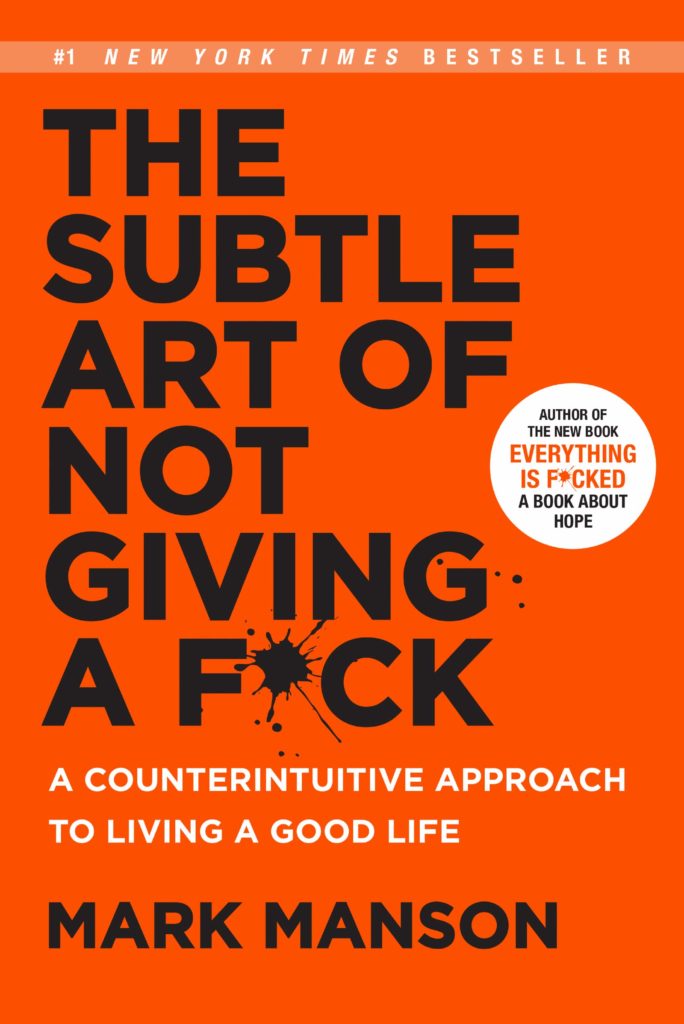
If you ask what kind of vocabulary attracts kids these days to pick up a book, it would probably be something like Not giving a fuck, or “Fuck it,” as this book does. Because I must say that I am not kidding about the popularity of this book at all. The Subtle Art of Not Giving a Fuck has a unique title that attracts strongly with the use of interesting words. This book written by Mark Manson has now sold more than 2 million copies worldwide and has been on Amazon’s bestselling book charts for 37 weeks straight.
Humans are social animals. Because of this sentence, it becomes normal for humans to be curious. We want to know about other people. We still seek knowledge, both good and bad, and search for knowledge in both right and wrong ways. Sometimes what we get back is not what we want, and it can even cause us extreme pain. Or sometimes we feel pain from information that comes to us even though we are just sitting at our desk. To prevent these problems, we must learn the art of “ f**k it. ”
“Don’t try to be someone you’re not.”
A lot of the self-improvement advice we get in life is to focus on what we lack. They talk about what we see as our personal flaws and shortcomings and highlight them to us. Society tells us to be more, more, and more positive all the time because it’s the right thing to do. And to be positive all the time, we have to keep repeating that message over and over again to really be positive. If the principle of doing something is good, many of us would have gotten better a long time ago. Because these things don’t guarantee that we’ll get better if we think positively and live better.
“The key to a happy and healthy life is not to care too much about everything, but to focus on what really matters.”
We tend to focus too much on things that don’t really matter, and this does nothing but make us feel bad about ourselves. The author calls this “ The Feedback Loop from Hell. ” Simply put, we feel certain feelings for no apparent reason, and having these feelings only makes us feel worse. The solution to the Feedback Loop from Hell is simple: stop worrying about your negative experiences, such as anxiety, anger, guilt, and fear. It’s okay to have these feelings.
“It’s okay to feel bad sometimes.”
Beating yourself up for feeling negative will only make things worse. Maturity isn’t about being able to handle everything that life throws at you, but rather about being able to take care of only what’s necessary. This simplification will help us to be consistently happy. We need to learn to be comfortable with differences, how to stay calm in the face of adversity, and how to be selective about what interests you.
“Happiness comes from solving problems.”
The truth is, happiness is a form of action. It’s not something that’s given to you passively. It’s not something you magically discover in a book. We’re so fascinated by the idea that being happy will permanently relieve all our suffering, but in reality, we have to solve problems. Happiness comes from struggle, and it comes from problem-solving and consistent action.
“True happiness can only be found when you find a problem you like and enjoy solving it.”
We all want good things in life. We all want to feel good all the time. People never think about the pain they enjoy, the things they are willing to fight for. We just want the rewards. No one is willing to go through this process. Most of us don’t want to struggle and try. Struggle is the key to happiness. We grow from problems. Even though we may encounter many disappointments, no matter where we go, there will be many problems waiting for us. The point is, we must not run away from problems, but instead find problems that we like to solve.
“No one is special and no one is specially exempted.”
Developing a high enough self-esteem to feel good and positive about yourself became popular in the 1960s. Studies have shown that people who think highly of themselves have fewer problems and live better lives. Researchers have since concluded that we are not all that special. There is no point in feeling good about ourselves if we do not have a reason to do so. Adversity and failure are always beneficial. They are essential for the development of successful, mentally resilient adults.
“People with high self-esteem tend to feel good about themselves. They feel like they are doing something special, even if they are not.”
A major flaw in the deep-rooted self-esteem movement in our society is that we want to feel good all the time and hold ourselves up in high regard. High self-esteem is telling us to feel special all the time, without realizing that we ourselves have become the new standard of failure. The most important step in solving our problems is to accept that we and our problems are no more special than anyone else’s problems.
“Simplicity is the thing we should be most grateful for.”
Many people are afraid to embrace mediocrity because they believe that they will never achieve anything, never improve themselves, and they cannot accept being told that their life is ordinary, but that they are not capable enough to make it extraordinary. However, the truth is that knowing and accepting our own worldly existence frees us up to do what we want without great expectations. So instead of seeing mediocrity as something bad, we need to avoid it, be grateful and appreciate the little things in life instead.
“Suffering is an important component of happiness.”
As human beings, we often choose to devote large parts of our lives to causes that seem futile or that destroy some shred of self-esteem. Sometimes we know deep down that we will suffer because of what we are doing, but we do it anyway, because the suffering means something to us, and because it means something, we can endure it and maybe even find some joy in it.
“Instead of avoiding the negative, embrace and confront it.”
Whether you like it or not, suffering is an inevitable part of life. The truth is that avoiding the negative often backfires. So instead of avoiding the negative, embrace it and confront it. Use self-awareness to combat it. The author, Mark, likens awareness to an onion. He says that an onion has many layers, and the more you peel them off, the more likely you are to start crying at inappropriate times.
- The first layer of this onion is the simple recognition of our own emotions. How do I feel? What is this emotion? “I am sad.” “I feel happy now.” “I see it and I feel sad.” It is easy for some people, but for others it is quite difficult because they tend to deny what they are feeling.
- The second level is the ability to ask why we feel or have certain emotions. Why do I feel that way? Why am I sad? Why am I depressed? Our personal values are made up of our curiosity.
- Level 3 is: Why do I see this as a success or a failure? How do I know my own thinking? What metrics do I use to judge myself and those around me? This level requires constant questioning and effort, and is the hardest to reach, but it is the most essential, because the nature of the problem is determined by our values, and the quality of our life is determined by the nature of our problem.
It is clear that knowing your values is important because they ultimately determine the quality of our lives. We need to change what we value and how we measure failure and success if we want to change the way we view our problems.
“It’s okay to not be optimistic all the time. Negative emotions are a key component of emotional health.”
Take responsibility for our lives and embrace uncertainty. That is how we will enjoy growth and progress. All personal development and growth comes from the realization that each of us is responsible for everything in our lives, regardless of the circumstances. We can only improve ourselves if we realize that we are responsible for everything in our lives, no matter what the circumstances are.
“Uncertainty is the enemy of growth.”
Embrace doubt and uncertainty. Instead of striving for certainty in life, we should continually seek doubt. Doubt our own beliefs. Doubt our feelings. Doubt about what the future might hold for us unless we go out there and create it ourselves. Stop trying to get everything right all the time. Find the moments when we are wrong. All progress and growth comes from uncertainty. People who believe they know everything never learn anything. To learn something, we must first admit that we do not know.
“Failure is the path to progress.”
Our improvement in anything depends on small failures, and the size of our success depends on how many times we fail at something. There are claims about talent that are exaggerated. Yes, they are exaggerated, because success has nothing to do with our preconditions. Rather, it has to do with what we do with how much effort we put in. In order to truly succeed at something, we must be willing to fail. If we are not willing to fail, then we are not willing to succeed.
“If you are stuck on a problem, don’t just sit and think about it. Just start working on it. Even if you don’t know what you are doing, doing the simple work will eventually bring the right idea to your mind.”
Mark, the author, got this advice from his math teacher. Using this advice, he found that action is not just a result of motivation; it is also a cause and it is related to motivation. So if we feel that we are not motivated to do something, start by doing small things and try to observe the results of our actions. Then we can try to harvest the results of those actions to motivate ourselves to continue doing.
“Rejection doesn’t bind you. It frees you from selflessness, so you can focus on what matters most.”
Saying no is an important life skill. It improves your life because it helps you focus on what really matters. If we say no to something, ask ourselves if we are standing up for it. For example, to build a healthy relationship, both parties need to be able to say no to small things, take time to sort out differences, set boundaries, and take responsibility for their own problems. Only then can true trust and acceptance be built.
“We should contemplate death from time to time in order to live life to the fullest, happiest and most fulfilling.”
We often avoid thinking about death because it frightens us. But death is the light by which the meaning of life as a whole is measured. If death were not involved in us as humans, everything would feel insignificant. All experiences would be arbitrary. All measurements and values would suddenly become meaningless. Deep reflection on death helps us appreciate life more. If we fear it or we are busy making sure others remember us after we are gone, we will never know.
Summary
The values that prevail in our society often teach people to think positively regardless of the situation. This constant positive mantra unintentionally teaches us to talk about everything that is real. We take it all in without realizing it. If we want to live a healthier and more satisfying life, we need to start focusing only on what really matters and nothing else. We pay too much attention to things that don’t matter, and this does nothing but make us feel bad about ourselves, and having this feeling makes us feel even worse.
The key to freedom is to stop engaging with our negative emotions, such as anxiety, anger, guilt, and fear. It’s normal to feel bad sometimes, and beating yourself up over certain emotions may not be good for you.
At its core, maturity is about being able to care only about what’s important. It’s this simplicity that makes us truly happy. If we try to do too many things in our lives, we’ll only end up with stress and misery. We all need to learn to let go of the things that hurt us, focus on what we really want to care about, and develop a more creative approach to work, love, and life.
“If you don’t have enough money, you will learn the best way to make money. If you don’t feel pretty enough, you stand in front of the mirror and tell yourself that you are pretty.”
Recommended articles :
Principles: Life and Work – Principles for living and working
IKIGAI – A Japanese-style concept for a happy and sustainable life
