


GRIT stands for effort, which is a key ingredient found in almost every successful person. But can it really lead to success?
Isn’t it the most unfair and unequal thing that people are born with? Moreover, this inequality is something we cannot choose. Even if our parents have a lot of money, they may not be able to use it to buy their children who are extremely intelligent from birth or have a talent that is born with a very high IQ?
All of this since birth makes it quite a bit of a pity for real-life competition. Why do we have to lose when we started from different points? Many people may have this kind of thought, right?
In a 2013 TED Talks Education, Angela Lee Duckworth , a psychologist who studies the power of grit, here called GRIT, says it can change the perception of inferiority in our talents, because it’s no longer necessary.

“Children with good academic performance do not have high IQs, and smart children do not have good academic performance.”
This is quite a contradiction to what most people understand. Most people still think that if you have a high IQ, you are a good student. This is a result of studying in school that uses grades as a competitive result that some parents want from their children very much. Even though some children do not have to be like that, low grades equal children who are not smart. High grades equal children who are smart. Is this what we use to judge in education?
Angela left her job as a management consultant at the age of 27. She started out in a slightly more challenging role: teaching seventh-grade math in New York City. She taught, gave, and graded tests like any other teacher. But the results made her suspicious. Her high-achieving students didn’t have the highest IQs after taking the IQ test, and the shockingly high students weren’t the best in their class.
“What we need in education is more understanding.”
Today, educators are quick to judge and reckon with their students based on those grades without any deeper understanding. We can understand children better by not just the grades on their transcripts, and not just by testing them for IQ because every teacher knows that there is more to life than just grades and IQs.
What if doing well in school and life wasn’t based on learning quickly?
Because everything shows that the IQ, learning ability and academic talent of most children are not the reason why they do well in school, and people with high IQs are not always successful. This fact made Angela quit teaching to pursue a master’s degree in psychology because she wanted to understand more about students and education.
“Who is successful? And why are they successful?”
Angela has been doing research with this question in mind all along. She has studied children and adults to find out which types of people succeed and why. She has gone to West Point Military Academy to analyze which cadets will stay or drop out, watched the National Spelling Bee to see which kids will win or go the furthest, studied new teachers working in tough places to predict which teachers will stay when the school year ends, and which teachers’ student populations will be the most productive.
She also had the opportunity to collaborate with a private company to analyze which salespeople would maintain their performance and make the best sales. From the different statuses, roles, and contexts in each case study that she studied, she discovered one outstanding quality, which was not good looks, not social skills, not physical strength, and not having a high IQ. But it was a matter of…
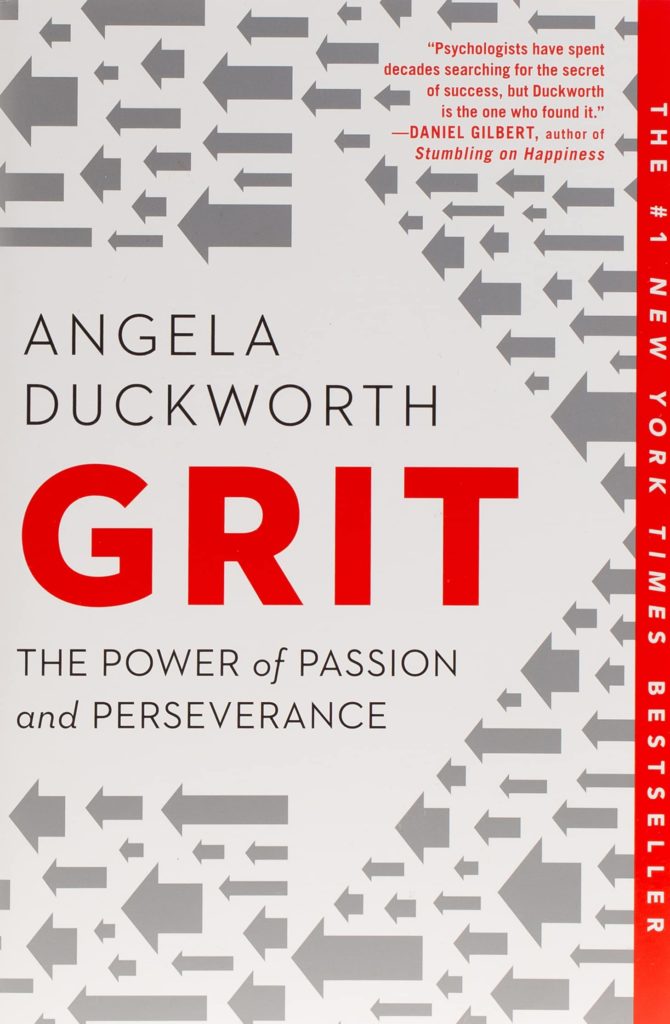
“GRIT – Perseverance”
She defined the meaning of “perseverance” as the desire, the desire to devote, strive, and struggle for the desired goal. For the most part, perseverance is a long-term action. It is patience, persistence, and taking time to achieve the desired results. The determination to move forward is not done in just a day or two, but in weeks, months, years, or more than a year. It is like running a marathon, where the finish line is the success we have set.
What does perseverance give you?
In her studies of grit, Angela found that students who persevered more often were more successful in school, not just in terms of graduation, but also in terms of academic performance. Compared to other characteristics such as family income, feeling safe in school, or standardized test scores, these factors did not have the same impact on a child’s success in school as perseverance.
“Talent does not help with effort.”
Although perseverance is a key factor in education and life, it is surprising that we have so little information about perseverance. How do we build it? How do people start to persevere? How can perseverance increase or decrease? These are all areas that need further research to find clear answers.
Angela said that what she is sure of now is that talent does not contribute to effort. From the information she has done in her research, she found that many people with amazing talents do not achieve the same success as their talents. It is similar to the story of the rabbit and the turtle. Because the rabbit was more talented at speed, he became complacent and did not make an effort. This is the point that clearly shows that talent and effort have nothing to do with each other.
Belief in growth
From all the research, Angela came across an interesting idea about fostering perseverance, developed by Dr. Carol Dweck at Stanford University. The idea came from her experiments where Dr. Carol taught her students about brain changes and growth, and how the brain responds to challenges and excitement. This learning made students feel that perseverance, even when they fail, was not permanent. If they keep trying, it can change.
“The ability to learn is not fixed and can be changed with your efforts.”
This idea really answers Angela’s question about student performance: why the kids who perform best don’t always have the highest IQs. Perseverance makes a difference in learning, not just in education, but in everyday life. In real life, your finish line may not be just grades, but in the great achievements waiting for you in life when you put in the effort.
Conclusion
From Angela’s study, we can see that it is a waste of time to be envious of other people’s talents. Those talents do not contribute to the effort at all.
The factors that make up success are also hard work. So instead of feeling inferior about your talent or the inequality that arises, it is better to take our time to mark the finish line and start running the marathon of our own life path now. We may reach the finish line soon.
“Because success doesn’t come from talent, but from hard work.”
Grit: the power of passion and perseverance | Angela Lee Duckworth
