

Learn from nature, let nature be your teacher, because if we want to survive in this crisis, we must understand and see the importance of nature, because nature has many answers and many wisdoms hidden, waiting for us to discover them.
In this article, we will discuss and understand more about the importance of learning from nature . What is it? From the perspective of Dr. Saranrat Kanjanavanich.
Natural Translator
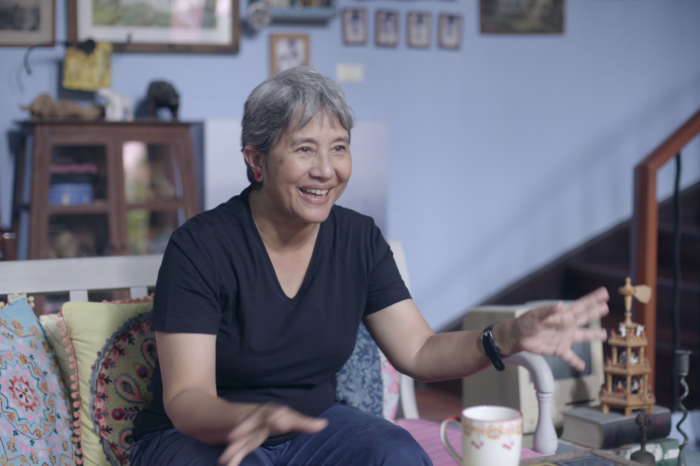
Dr. Saranrat Kanjanavanich said that she is the last generation of city people who have lived close to nature. That is the main driving force that made her interested in studying about nature and the environment, including working in environmental conservation with the Green World Foundation since 1995. She is currently the Chairwoman of the Green World Foundation, an environmental researcher, and also drives many nature conservation activities, such as the Environmental Detective Project, Bicycle in the City, and Citizens Change the City.
Dr. Saranrat has an interesting perspective on life and nature based on her lifelong knowledge and experiences, and pointing out the true beauty and connection between nature and humans is one of her constant endeavors.
Integrate your body and mind with nature
Both Holistic Learning and Transformative Learning are concepts that focus on learning to develop human potential. Dr. Saranrat’s learning stories, interests, and work throughout her life confirm that she is a learner who blends both forms of learning concepts harmoniously. And what she is interested in, to the extent that she may be considered the teacher who has given her the most ‘understanding’, is nature.
“We emphasize learning from nature, using nature as our teacher, because if we want to survive in the environmental crisis, we must understand and see the importance of nature, and embrace the nature around us to help our lives. Because nature has many answers, many wisdoms are hidden in nature around us. If we don’t learn from nature, we will have no way out, because the traditional wisdom that the previous generations have accumulated has already shown the results of how much it has destroyed the world. We can’t use the old methods anymore, we have to learn new things,” said Dr. Saranrat, talking about learning from nature. She gave an example by asking a picture-provoking question about whether, in the future, people will need to use the method of blasting mountains to make cement. She pointed out that sometimes we can learn about this and find answers from our fellow creatures, corals and shellfish.
Dr. Saranrat said that nature is more profound and related to human life than many people think. The human learning system does not only come from the analysis within the brain. Because before the brain starts analyzing, our body has already observed to receive information through the sensory system that is deeply connected to the nature around us.
Inside connected to the outside nature
“Why do we have to learn from nature?” Dr. Saranrat asked us, “Because we are surrounded by nature. If we don’t understand what happens inside us and how it relates to the outside, we will have many problems in our lives.”
Dr. Saranrat said that the practice of understanding the connection between ourselves and nature is that humans must build a relationship with nature, reduce the use of electronic tools and technology such as social media.
“Nowadays, if we want to know something, we just open Google. It’s good because we have access to a lot of information. But using a lot of technology stimulates our senses, but it’s just a rough sense. If we slow down, turn off the screen, turn off the phone, we will be able to perceive things in more detail. Everyone must have at least one moment in their life where they feel very happy, joyful, happy, peaceful, and at one with nature.
We have to think back to when that moment was in our lives. It might have been one night when we woke up and saw stars all over the sky because that was the time when our brain waves slowed down. When we perceive more clearly, we can feel the connection with everything around us, whether it’s a dog, a cat, a tree, a blade of grass, a starlight, or anything else. We feel one with them,” said Dr. Saranrat, referring to the connection between nature and humans.
Grow naturally
As a child, Dr. Saranrat grew up in a nature that was still abundant, which made her have a connection with everything around her. When she grew up, her main interests were nature and the environment. Although she spent a short period of time searching for her identity as a child by studying art, when she realized that it was not what she was truly interested in, she searched for a new path by experimenting with various careers, such as being an interpreter for journalists, working in advertising, and even setting up her own company. All of this can be said to be a learning process in finding a clear identity, which, to some extent, has sharpened her thinking and skills.
After gaining more clarity about herself, she chose to return to school to pursue a bachelor’s degree in environmental archaeology, a field where she discovered true joy in learning.
“Archaeology and geography are similar but different in terms of the ancient time period and the present time. Both disciplines are about the relationship between humans and things in this world, which is something I really like. Especially when I studied deeply about the connections between geography and various ecological systems, I could understand and see all the connections. Our various interests began to connect. Taking everything we were interested in and connecting them made learning very enjoyable,” said Dr. Saranrat, recalling the learning that led her to be interested in studying nature and the environment for the past decades.
“But studying archaeology that must be applied to modern ecology makes us find answers that can be applied, find knowledge that is directly useful, which makes us even happier,” Dr. Saranrat happily told us.
Learn from self-exploration
Dr. Saranrat emphasizes self-exploration and her life is a good example of finding oneself, finding what is right. She not only thinks but also practices to find the answer from her life hypothesis.
“We give time to explore and experiment, which we think is not strange because for some people, it may take a long time to find out what they like. For example, when we graduate from high school in England, it is normal for children there to not go to university immediately. It is called a gap year. It is a good thing that we can open our eyes to the world and try many things. We have to go to many places. It is a time that allows us to see many things. It is a learning period that is suitable for some children who do not know what they want yet. And this is the importance of leaving a wide space for self-exploration,” she advises from her own experience.
From the time she was searching for herself and finding the field that she was interested in and passionate about, Dr. Saranrat continued her studies to master’s and doctoral degrees in ecology. After that, she joined the Green World Foundation to work on environmental issues in Thailand at various levels.
“Working in an environmental organization is a way to learn about the nature that suits us because through working, we can clearly see why we do things.”
Dr. Saranrat said and shared that his interest in working in environmental conservation stemmed from his childhood experiences where he had close contact with nature.
“We are the last generation of city people who got to experience nature directly. For example, standing on Sriracha Beach and seeing a baby shark washed ashore, we had to dig a pond to save it. That was normal life as a child. We could easily access the wild because at that time, nature had not yet been controlled by humans. But later, with development, things that were once easily accessible are disappearing.
Therefore, it is not surprising that people of our generation come to work in environmental conservation because we have a connection and good experiences from childhood growing up with nature. Therefore, working in conservation means working on something we care about, something we love,” Dr. Saranrat Kanjanavanich, Chairwoman of the Green World Foundation, explains the past that is an important factor in her learning by heart.
The story references an interview with Dr. Saranrat Kanjanavanich.
From the Transformative Learning Project
Supported by the Health Promotion Foundation (ThaiHealth)
For more articles about the Transformative Learning Project, please visit:
Ms. Rosalina Alexander McKay Learning never ends. Everyone can learn with the right teaching method that suits them.
Miao – Pilanthan Thaisruang learns through working with people and communities to bring out their potential.
