


Zero Hunger: Reducing hunger is another important goal under Sustainable Development Goal 2 because the problem of hunger has become a global problem.
As the world’s 5th largest food exporter, who would have thought that Thailand would still face food problems such as malnutrition (stunting)? Although data from the latest SDG Index found that Thailand has fewer children with malnutrition and emaciation, there is an increasing problem of children with malnutrition. What is the cause of this and what is the solution? We invite you to find the answers with real voices in the food industry.
- Mr. Prasert Boonduangprasert, Chief Executive Officer, Charoen Pokphand Foods PCL (CPF)
- Mr. Phrutthi Ketchuchuen, Managing Director of Dairy Home Social Enterprise Co., Ltd. (Dairy Home)
- Dr. Decha Rat Sukkamnerd, Economist
The three of them had the opportunity to discuss the Sustainable Development Goal 2 , which is about reducing hunger (Zero Hunger), which is considered an issue of great importance both in our country and on a global level.
Produce more, export more, food prices are more expensive.
Dr. Decha Rat raised the issue that Thailand is the world’s 6th largest exporter of vegetables and fruits, but found an interesting figure that only about 38% of Thais can consume the recommended amount of vegetables and fruits by the World Food Organization, which recommends consuming about 400 grams of vegetables and fruits per person per day. This comes from the fact that the amount of vegetables and fruits left over from exports is less than 400 grams per person per day. It also points to the country’s challenge that even though Thailand produces a lot and exports a lot, domestic consumers themselves are unable to consume vegetables and fruits to the level that they should.
Especially in the COVID situation, there is an overlapping problem, which is that about 20% of the country’s low-income people have limited purchasing power, requiring about 48% of their total expenses to buy food. Moreover, since 2005, food prices have increased faster than general inflation. Even during COVID, general product prices have decreased, but food prices have continued to increase. Therefore, it has become a heavy burden for low-income people, even though COVID has already reduced their income.
Challenging issues during lockdown
Mr. Prasit added that CPF, as a leader in food production from Thailand for distribution around the world, places importance on food security, especially during the COVID situation. CPF is aware of its duty to help create food security for Thailand under the philosophy of 3 benefits: benefits for the country in which it does business, benefits for the people, and benefits for the company. During the crisis since last year, there was a panic that there might not be enough food. CPF has held several meetings with the government to prepare for the situation, using knowledge from the COVID situation in Wuhan to plan ahead to produce and distribute food to cover all areas.
Mr. Prasit also told us that the challenges during the lockdown also included transportation because product distribution is not just about food, but also includes other necessary materials such as packaging or raw materials that will enable food production. However, we received great cooperation from all relevant parties. In addition, CPF has also helped reduce the burden on the Ministry of Public Health, especially doctors and nurses who protect the country, by volunteering to support food for approximately 80 hospitals nationwide and 2 other main points: Bang Sue Central Station, the largest vaccination site of the Ministry of Public Health, and the Ministry of Labor, which has vaccination points for insured persons throughout Bangkok. All of the missions that CPF is committed to are in line with the Good Corporate Citizen policy or being a good citizen of the country.
Manage costs, increase production capacity, add high-nutritional foods
Mr. Prasit also opened his perspective as a leading food manufacturer that the most important thing in the food business is to manage costs effectively, increase production capacity, and increase production capacity to produce more from the same amount of investment, space, and resources. Today, CPF is trying to use more strategic knowledge, especially in Robotic Engineering and Software AI, to help increase the efficiency of using the same space to increase productivity more than before, to reduce costs and allow consumers to access the most food, along with developing food products to have more nutritional value per consumption, whether it is developing Plant-based or plant-based meat or other products to increase product variety, helping consumers to have more choices.
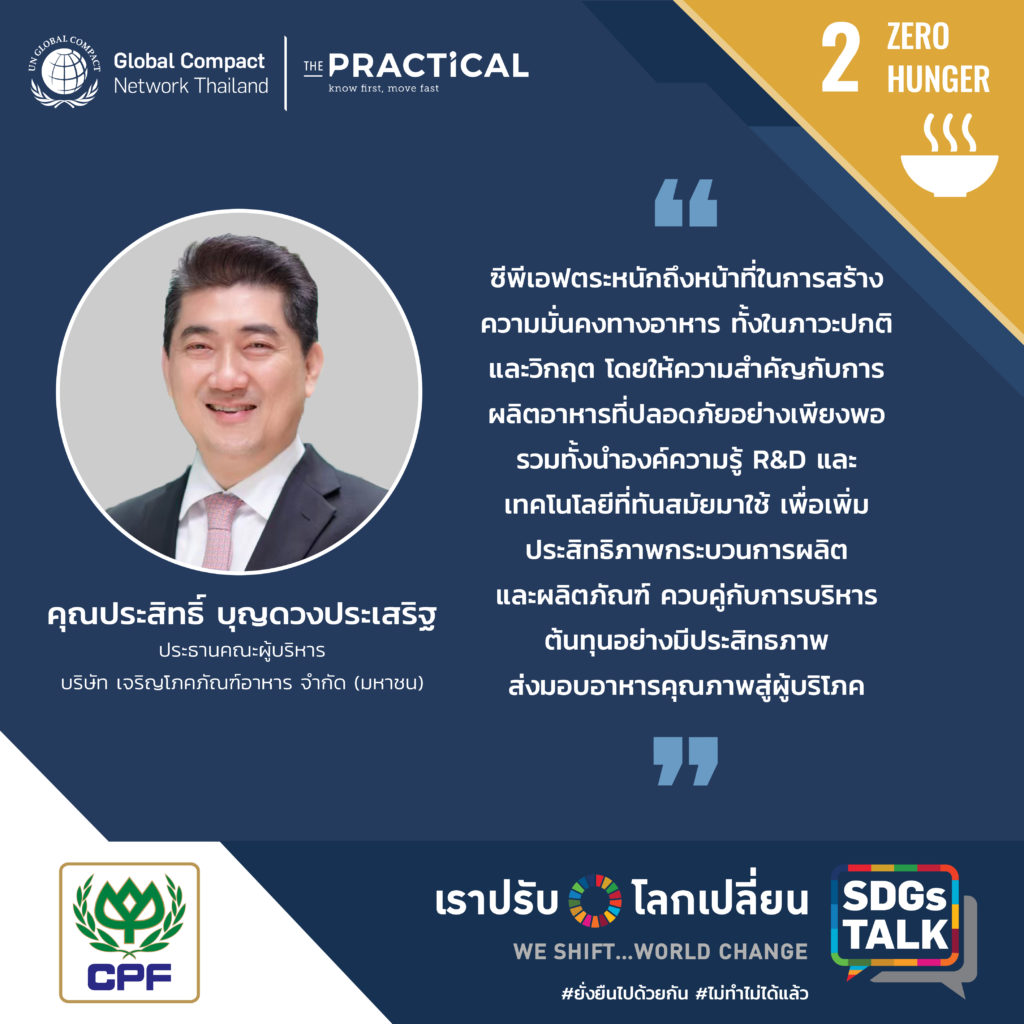
In each year’s portfolio, there must be a Healthy Food Concept, such as making meat more nutritious or meeting the Balance Need more, such as a bowl of food that has vegetables, rice, and meat in one pack for consumers’ convenience, and other functional foods that are under development, such as beverages and food. In addition, CPF also has many projects that help people access food, such as the egg-laying chicken raising project for school lunches for approximately 855 schools along the border, which uses a team from all over Thailand to volunteer to advise teachers and teach students to be able to raise egg-laying chickens with low management costs. In addition to learning how to raise egg-laying chickens and get food, they also sell it to the community; the Happy Future Planting Project to help educational institutions near the factory, approximately 90 schools; and projects from by-products, such as using chicken or pig manure to make fertilizer for communities around the factory to reduce fertilizer costs, eliminate unwanted items, and create added value for those involved.
Self-sufficient agriculture and organic food: the source of safe and sustainable food
Mr. Phrut from Dairy Home stated that to truly achieve food security in Thailand, we need to look after the supply chain to see what we can do ourselves without having to rely on external factors, especially nutrition issues. The most important issue, after hunger, is eating the wrong foods and the increasing number of obese people.
There is still the issue of the thinness index of Thai children. The question is how to create a balance in these matters. Mr. Phrut shared his experience working at Dairy Home, which is a small organization that focuses on dairy farmers to be a model for organic farming.
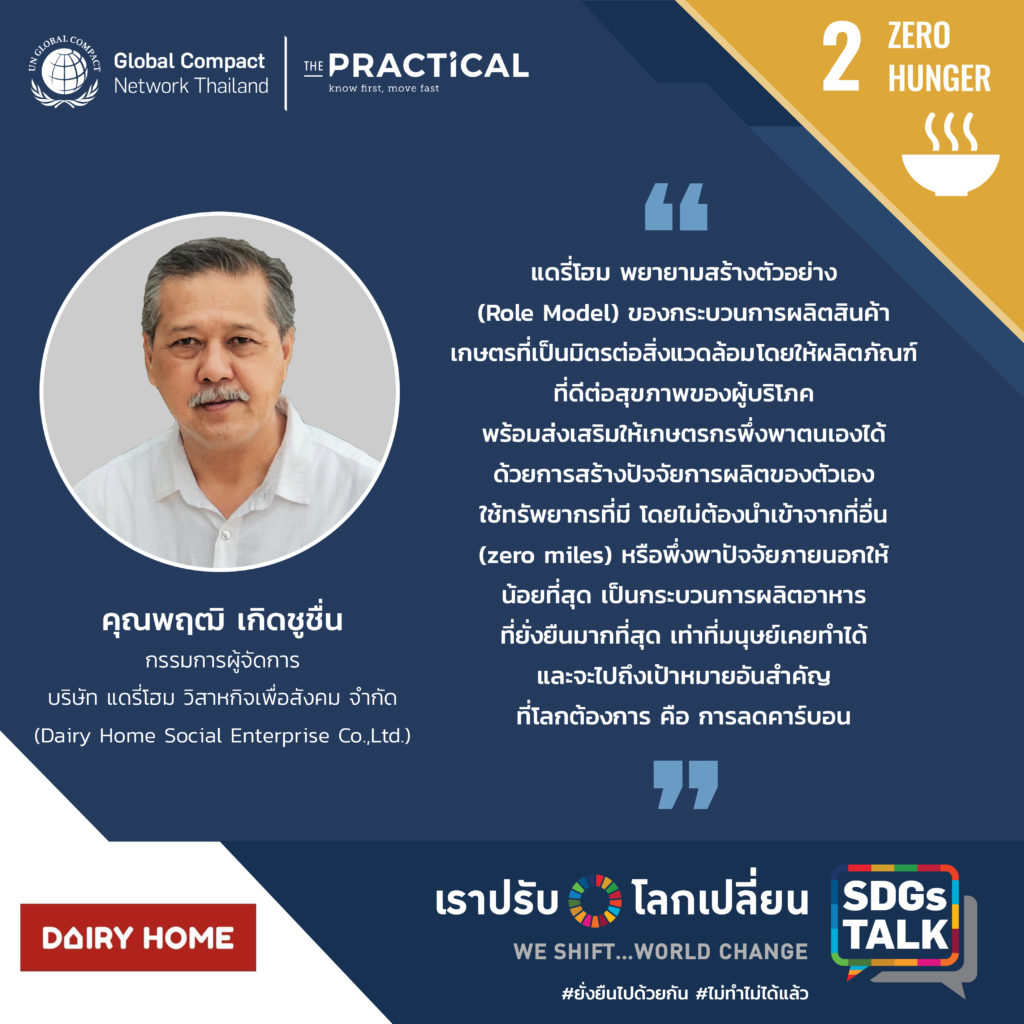
Dairy Home is trying to develop a milk production process that is environmentally friendly and good for consumers’ health. At the same time, farmers must rely on themselves by creating their own production factors or relying on external factors as little as possible in order to become complete food producers. They believe that being able to produce food completely will be the most sustainable food production process that humans have ever done and will help push society towards the environmental goal that the world wants, which is reducing carbon. In particular, the food production process in Thailand should be zero miles, meaning no imports. It must be able to use the resources on the farm that are available for production, which is a model that is more than halfway developed. Currently, Dairy Home dairy farmers can rely on their own production factors by up to 80%. If a farm can produce 100% of its food, the farm cost will be much lower because there will be no logistics costs, packaging costs, or unnecessary costs, which will allow almost total carbon emissions to be reduced.
Short food supply chain: a solution for food security
Dr. Decha added that the overall picture of food security and sustainability is not worrisome, but there must be a supplementary system to distribute to help in small areas. He suggested that the future approach should use a short food supply chain in the community or provincial level. He cited figures from the Office of Health Promotion that brought vacant land for communities to grow vegetables. It turned out that an area of approximately 400 square meters could grow enough vegetables for approximately 22 people, which is equivalent to taking care of almost 100 people per 1 rai of land. It can be seen that the short food supply chain has a lot of potential because in addition to being consumed by the people themselves, they can also be sold. This sale will allow the supply chain to grow even more.
However, developing a short food supply chain also requires taking into account other important factors, namely land and access to land. It is not necessary to have a large area of land, just 1 ngan. If it is distributed in different places, it can be done. And importantly, there must be water. Some people have their own land but no water, so they cannot continue. This requires a small investment, in addition to field crops. In addition, when there is a need to sell, there must be a market to support it, which may be a school. Local food or a short food supply chain will help supplement the main market a lot, especially by giving people more purchasing power. It is an opportunity for people in need to have easier access to food, and it makes the country better as a whole.
Future food recipes, cost-effective, environmentally friendly, high nutrition
Mr. Prasit emphasized that in creating value for the food business in the future, what needs to be further developed is production efficiency. How can one rai or one area increase production? When there is one person per family as a team, such as a community enterprise, to unite the strength of people in the area to increase production, each person’s knowledge has a variety of people. When people join forces, production efficiency is improved, service costs or cost to serve are reduced, and it helps create competitiveness for Thailand. Another issue is electricity and water, which are key infrastructures in deciding to invest in expanding a business. In investing in expanding a business, if we can develop the efficiency of the irrigation system to be the same as the electrical system, it will reduce the cost of agriculture in Thailand, the cost of selling, the selling price will be cheaper, and the efficiency will be much better.
Mr. Phrut added that if farmers are stable, can produce food sustainably and are self-reliant, have a short food supply chain, production costs will be lower. If we can use the most efficient area without harming the environment, and understand how to manage the circulation of nutrients in the natural environment, we will be able to produce food at a low cost but sell it at a high price. He gave the example of farmers in the Dairy Home network who sell milk at normal prices and still get a higher price than other farmers because the milk has a higher solid content of nutrients.
Therefore, it is a model that I would like farmers to turn to take care of resource management first. If it can be done, the production cost will be very low. No matter how the market price changes, there will be little impact. In addition, it can also enhance biodiversity because raising animals on the farm can raise many types that support each other, such as raising chickens alongside dairy cows. The chickens help eliminate insects that bother the cows. And using a system of living things that support each other like this will make the cost low.
In addition, the factory also tries to use the concept of Zero Waste, nothing is thrown away, plastic, paper can be turned into money, or doing an Upcycling Waste project, such as nutrients left over from washing milk production machines, which have high BOD values, resulting in very high treatment costs, are used to feed algae, and the algae are used to feed sea urchins, and the sea urchins are used to feed giant freshwater prawns, which this research has been completed, is being expanded commercially, and SMEs are welcome to learn.
Food Safety – Food loss – Food Waste Towards Sustainable Food
In creating a sustainable food system in the future, Mr. Prasit emphasized that zero hunger is one of the factors that CPF considers regularly because access to food and reducing hunger among people are very important. He considers food security as one of CPF’s duties, both in normal times and in times of crisis, with food safety as one of the main goals, including efficient production and reducing food loss in the production process to a minimum.
Considering how it can be used to create added value or whether it can have a lesser impact on the environment. It will consider which parts of the production system are wasted and affect natural resources that should be used carefully and thoughtfully. Finally, there is the issue of reducing food waste, which occurs in about one-third of all products. Cooperation will be created in the entire supply chain system to improve management and reduce food waste sustainably.
3 systems to meet the needs of sustainable food, transforming Thailand
Dr. Decharat concluded that to meet the challenge of sustainable food in Thailand, both in terms of the economy and in terms of Zero Hunger, 3 systems should be used in tandem: Highly Efficient Supply Chain, focusing on efficiency and competitiveness, not only producing domestically but also meeting consumers worldwide; High Value Supply Chain, such as organic products, environmentally friendly products, products that provide special experiences, such as community tourism, are products that modern consumers value and are willing to pay for; Thailand will benefit more from this, and it will also help reduce environmental and health problems; Local Food Supply Chain or Short Food Supply Chain, adding water, production factors, production techniques, and marketing mechanisms, by connecting the new generation to solve this problem. If Thailand can make all 3 supply chains consistent, it will be the answer, and when they are better coordinated than before, it will be the future of zero hunger, and I believe that Thailand can do it.
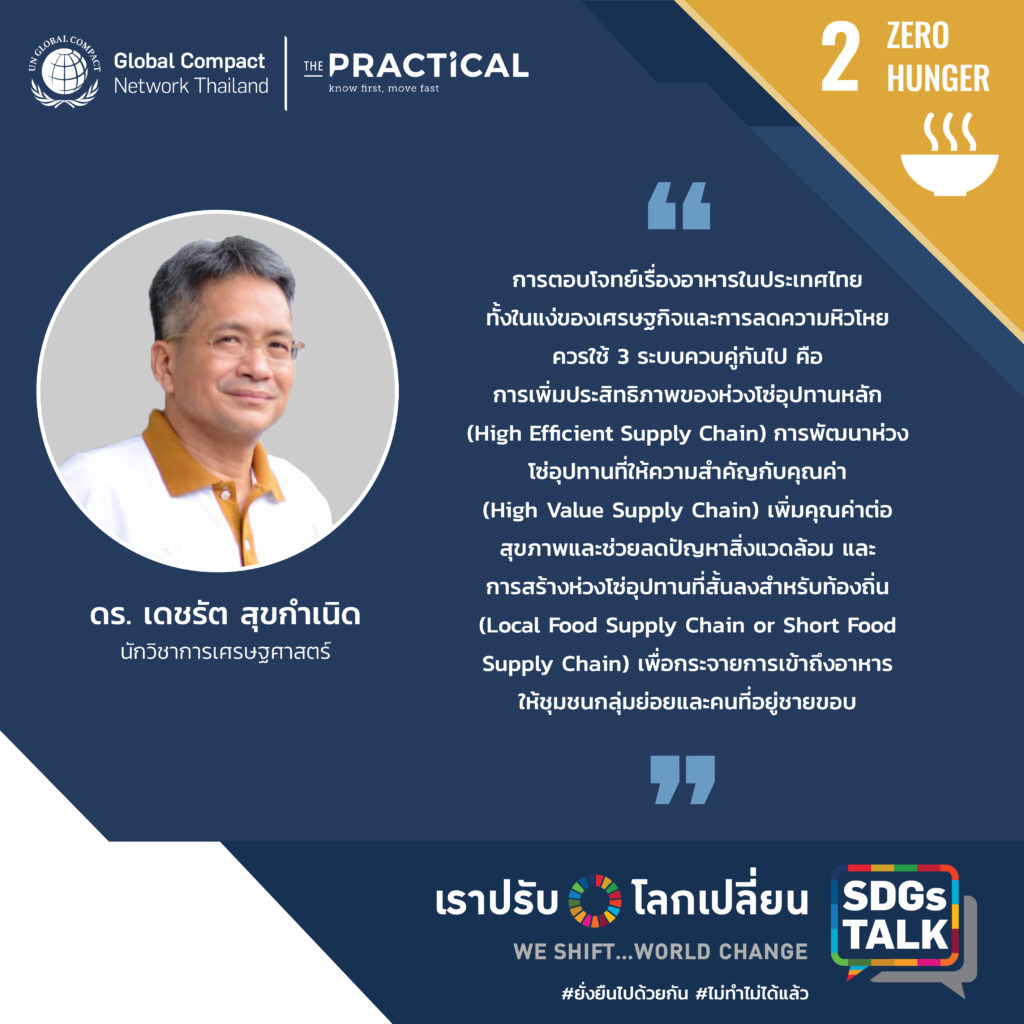
And these are the views and experiences of the three panelists on the topic of food security to zero hunger, which is a sustainable food challenge that will transform Thailand in the near future.
….
“We Shift…World Change” program
Episode: “ Food Security to Zero Hunger ”
Or you can choose to listen to the program in Podcast format at:
Follow the program “We Adjust…World Change We Shift…World Change” on Facebook
via Facebook page @ New Generation Salaryman or Facebook Global Compact Network Thailand and The Practical’s Social Media channels.
